
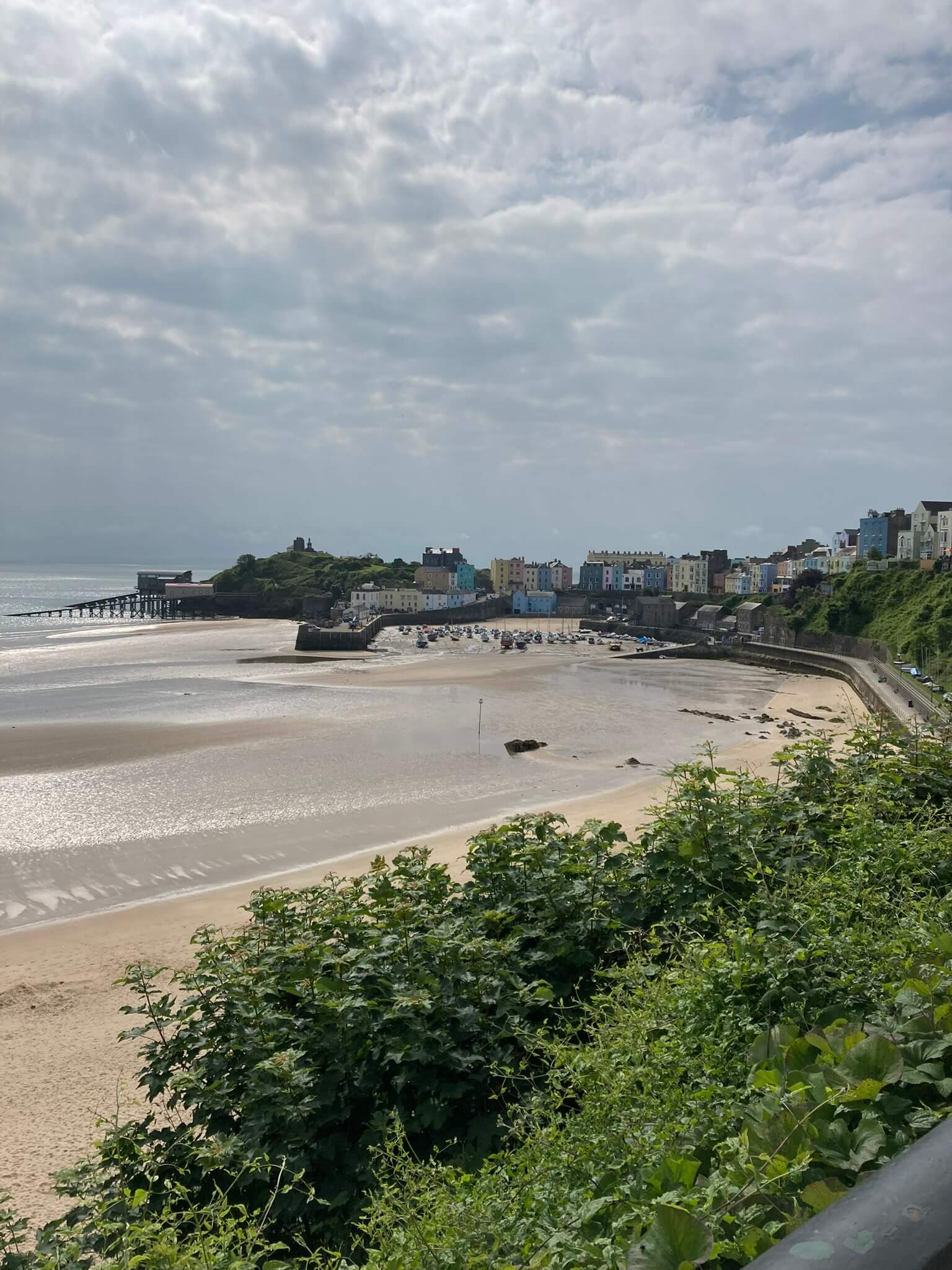
Wales has to be one of the most underrated and beautiful places I’ve visited. Most people spend time in England, Scotland, and Ireland, but why not Wales?
I think the British have been keeping this place a secret because they don’t want the rest of us to find out how great Wales is.
In our road trip across the south of Wales, we visited enchanting forests, lush valleys, pristine beaches, cute fishing villages, and historical sites.
Read on to find out why you should visit South Wales, and some of the places we loved along our road trip.
Why did we visit South Wales?
Originally, our South Wales Road trip was purely out of necessity.
We needed to get from London to Ireland for a conference, BUT… None of the aircraft flying this route could accommodate my wheelchair (only wide-body, larger aircraft are big enough to store my wheelchair in the cargo hold).
Our only option was to drive from London across Wales and catch a ferry across the Irish Sea.
Why should you visit South Wales?
What originally started out as a bit of an annoying detour get to the conference, turned out to be such a pleasant surprise. As I started researching South Wales, I was gobsmacked by how beautiful this area was. The more I researched, the more places I wanted to visit.
As we needed to be in Ireland for the conference, we only had 1.5 days to see the south of Wales. In hindsight, I would have planned more days in this area as there is so much to see.
This area has something for everyone – history, beautiful scenery, family friendly activities, and Wales is very proactive in terms of accessibility, with lots of accessible options.
About Wales
if you are anything like me, before our trip I knew almost nothing about Wales, or even where it was located (I actually thought it was north of England until I looked at a map – it’s not, that’s Scotland). Wales is located on the western side of England – between England and the Irish Sea.

Wales is part of the United Kingdom and has a population of around 3 million people, who mostly live in the main cities of Cardiff and Swansea. The rest of the country is full of open spaces and small towns. The people are super friendly as well.
The little I knew of Wales came from historic novels and TV shows, all of which portrayed Wales as a depressing country full of sheep farms, coalmines, and never-ending rainy days. I’m not going to lie, we did see a little bit of that, but there was so much more!
At only around 150 km from east to west, it only takes a few hours to drive across the country and see the landscape change dramatically. The south of Wales gave us everything from forestry, lush valleys, epic mountain ranges, white sandy beaches, cliffside fishing villages, wetlands, and tons of castles and historic ruins.
Our road trip route
We started our South Wales Road trip in the Cotswolds, entering Wales from Gloucestershire in England.
We took a scenic drive along route A466 through the stunning Wye Valley, which is a 30-mile route through Monmouthshire on the English/Welsh border. This route snakes through the Wye Valley with the river alongside the road in many places. Including stops, this took around 4 hours.
At Tintern, we headed across to the A465, a major highway, across to Tenby on the West Coast. This took about 3 hours with a brief stop.

Although this was a major highway, and we did see some industrial areas and windfarms, it was quite scenic. The highway took us past Raglan Castle, the Brecon Beacons (beautiful mountain range with some of the UK’s highest mountains), and some nice countryside.
We spent the night at Tenby on the Pembrokeshire (south-west coast), before catching a ferry from Pembroke across to Rosslare in Ireland.
The Wye Valley and Forest of Dean
This Valley was full of beautiful scenery and hidden gems. We found ourselves on a quiet road that wound alongside the river Wye through rolling hills. This eventually turned into dense forestry of the Forest of Dean, where trees lined the road as far as the eye could see. Driving through the forest, this area was giving off “forbidden forest” vibes.

Symond’s Yat Rock
Nestled in the Forest of Dean is Symond’s Yat Rock, a rocky viewpoint with stunning views over the Wye Valley.
The view from the lookout was incredible. We had panoramic views of the river Wye winding through the lush green valleys. To the left, we looked down on Symond’s Yat township. To the right, birdwatchers pointed out some peregrines nesting in the cliff faces.

The great thing about this viewpoint was that it wasn’t crowded and was easy to move around. Aside from us, there were a couple of school students on excursion and fellow hikers. As dog lovers, we were excited to pat lots of spaniels who were out enjoying the forest trails.
There is a nice little outdoor café at Symond’s Yat Rock where we stopped at for a coffee and snack. The café stocked savoury and sweet snacks, including several gluten-free and lactose free options.
The serenity of the forestry, with the sun streaming down on me through the trees, while sipping on a decadent Nutella hot chocolate was heavenly!

Next, we took a stroll on the Well-being trail, one of many accessible trails available at Symond’s Yat Rock. We spent about 45 minutes wandering this 2 km (1.2 mile) trail, deep into the forest.

Along the trail, native broadleaf trees, ferns, moss, and gorgeous purple foxglove flowers surrounded us.

The well-being trail also had several “well-being panels” signposting the way, with mindfulness activities such as stopping to notice the different shades of green in the trees, to remind you to stop, relax, and take in the surroundings.

Symond’s Yat township
Finally, we made a quick stop at Symond’s Yat. Symond’s Yat is actually 2 townships (East and West) separated by the river. It is a 10-mile drive around the valley if you want to visit both east to west.
If you are a fan of the Netflix series “Sex Education”, you will recognise the scenery of Symond’s Yat, where the show was filmed. This Valley was just as pretty as it looked in the show. I even caught a glimpse of Otis and Jean’s red house on the hillside.

Accessibility at Symond’s Yat
There is disabled, blue badge parking and an accessible toilet block near the entrance to the trails.
The trail to the viewpoint was 300 m with a slight uphill incline. The trail was mostly bitumen and sealed gravel with a short timber boardwalk. I found the boardwalk got mega bumpy when I picked up too much speed.

The viewpoint has a rock wall for safety, but it is low enough that I was able to see over it in my wheelchair. There were also wire sections and some raised rocky areas that allowed me even better visibility down into the valley.

The café had flat access to get to the counter and display cabinets. The counter area was undercover away from the weather however seating was picnic tables outside. We did find that the surrounding forestry did shelter from the wind quite well.
The well-being trail was mostly hardpacked gravel that was reasonably smooth. Most of the trail had a gentle incline, although there was one section midway where my wheelchair tyres lost traction on a downhill section with some loose gravel. This led to a little “weeee” moment as I slid a metre or 2.

To tackle some of the more difficult trails, all-terrain mobility scooters are available for hire from the nearby Forest Holidays.
Tintern Abbey
Following the river down route A466, we stopped at Tintern Abbey, a ruined old Abbey founded in the 12th century. The roof is missing, but the walls are mostly still standing, with grass growing in through the courtyards.

You can pay to go through the Abbey. However, we found that we could see enough of the Abbey from the outside and through the windows, so didn’t go in.

Instead, we had lunch right next door at The Anchor Inn. Being a Sunday, we got to enjoy the most scrumptious Sunday carvery lunch – several meat options, vegetarian nut roast, amazing Yorkshire pudding, and all the trimmings.

The Sunday roast also came with a fantastic view, overlooking the river, township, and the Abbey.

Accessibility at Tintern
The Tintern Abbey is wheelchair accessible. There are some paved areas and ramps inside the Abbey for wheelchair access. As I did not go in the Abbey myself, this is just what I could see from the outside (which was plenty for me anyway).

The Anchor inn did have a couple of split-level areas, however there is flat entry into the main dining area and step free access into the carvery. There was also a lot of outdoor seating that is accessible as well.
Tenby
Everyone that I speak to about Tenby says the same things. “I love that place”, “wasn’t it so cute”, “it’s so pretty”.
Tenby is a little fishing village that sits on the cliffs overlooking the ocean on the south-west coast of Wales. The prettiness of Tenby doesn’t just come from the cliffs and white sandy beaches, but also the colourful painted houses and quaint little streets set among old town walls and castles.

We spent a night in a blue cottage that sat on the cliffs overlooking Tenby’s North Beach. We enjoyed an evening stroll down to the beach and through the town, where we grabbed a light dinner at a pub.

The next day was a beautiful sunny day, perfect for a slow morning exploring the town.


Tenby is quite a small town and therefore very walkable/rollable. We spent several hours just strolling through the town, looking at local shops and painted buildings.
There were lots of local shops selling lollies, clothing, and local produce. Local cafés, pubs, and fish and chip shops were also dotted throughout the town.

There were also some historic parts of town to explore as well. Tenby harbour was filled with little fishing boats, seagulls, and the waft of seafood in the air. This was a good opportunity for us to have fish and chips (with vinegar) overlooking the harbour.

We also found a lovely viewpoint near the castle overlooking Castle Beach and South Beach. This area had some pretty gardens along the castle walls. There were also sections of old walls throughout the town that added to the charm of the town.


Accessibility at Tenby
Tenby is located at the top of cliffs but is relatively flat throughout the centre of the town. There are a few inclined streets as you move away from the town centre.
The streets are small and had very little traffic. In most cases we were able to stroll along the beach and streets. The foot paths were smooth, but quite narrow in places (hence it was easier to drive on the streets).

There were only a few cobblestoned areas in the older part of town, but compared to other cobblestones I’ve driven on, these were relatively nice ones. I did find my small ramps handy, as many of the shops did have a step and some curbs cutouts were missing.

We stayed in a blue townhouse on North Beach. While it wasn’t 100% wheelchair accessible, we made it work for the night. It had flat access and a big enough bathroom we could manage in. If you are looking for something more accessible, there is a Premier Inn right in the centre of town that would be perfect.

Most of the beaches are accessible via concrete ramps down to the sand. I only went down the North Beach ramp, it was a little bit of a steep incline in places with a gradient of 1:6, but it was still fine for my power wheelchair.

Some of these beaches have beach wheelchairs available that you can hire – see website for info.
Places we would visit if we had more time
We only scratched the surface of South Wales, and through my research I discovered many more places I’ll need to go back and visit.
The Brecon Beacons National Park has some of the UK’s highest mountains and some beautiful nature experiences.
The Gower Peninsula, just to the south-west of Swansea, is recognised as an Area of Outstanding Natural Beauty. This area has pristine white beaches and lookouts, many of which were accessible.
Pembrokeshire was full of attractions including Pembrokeshire Castle (accessible outer grounds and ground-level), accessible beaches, clifftop walks, wetlands, and family friendly attractions such as Folly farm (this gets a thumbs up from me as the website had pictures of people in wheelchairs visiting).
Overall impressions
Wales is an off the beaten track destination that is well worth visiting. Surprisingly accessible, there is plenty to see and do for everyone. From a quiet day at the beach, coffee in the village, theme parks, nature trails, or even something more adventurous, Wales has lots of options.
While we did a fast drive through Wales, it is the perfect place for a slow travel break.
Wow factor: 4.5/5 Surprisingly beautiful.
Cobble index: 3.5/5 Outdoor trails are a little bumpy (as they should be), but not too many cobblestones in the towns.
Barrier free barometer: 4/5 Wales have made a huge effort to make beaches and attractions accessible. There are several accessible accommodation options.
Want more info?
There are some great websites with information about accessible attractions and accommodation in South Wales:
For more information about nearby destinations, check out some recent blog posts:
Oxford and Cambridge in a wheelchair
Wheelchair friendly self-drive road trip in the UK and Ireland