
Oxford and Cambridge are England’s oldest, most iconic, and prestigious universities.
The question is, if you are visiting England, should you visit Oxford or Cambridge? Or both? and which is best for visiting in a wheelchair?
I visited Oxford and Cambridge in my power wheelchair in June 2025. Read on to find out about which I liked more and why.
About Oxford and Cambridge
Oxford was the first university in England, founded in 1096. Cambridge was founded later, in 1209 after several academics fled Oxford following a dispute with the townsfolk. Ever since, the universities have been fierce rivals!
Having heard about the long rivalry between Oxford and Cambridge, I assumed they were located very close together. In reality, they are located quite far apart –Oxford is 1-2 hours West of London, while Cambridge is located 1-2 hours north east of London.
Oxford
As someone who has spent a lot of time at universities, of course, I would spend my vacation time visiting another university! Oxford has long been a bucket list item for me with its beautiful old buildings, history of scholars, and Harry Potter film locations.
But something I didn’t know about Oxford before visiting was that the town of Oxford is built around Oxford University. Unlike most other universities where there is a large, single, centralised campus, Oxford has numerous colleges spread throughout the town among shops and pubs. The colleges don’t have public access, but some tours will get you inside.

Oxford walking tour
We booked a three-hour customised private walking tour with Oxford walking tours.
Our guide was Jonathan, who was given the task of providing us a tour based on student life at Oxford with a bit of Harry Potter thrown in.
On the Harry Potter side of things, Jonathan was the perfect guide. He told us he saw Emma (Watson) walking her dog through Oxford that morning. He also casually talked about his friend Joanne (a.k.a. JK Rowling) and how he was an editor for punctuation in Harry Potter and the Philosopher’s Stone – who knew someone’s entire job was to check commas?
We visited several Harry Potter filming locations, including The Divinity School (Bodleian library), which was transformed into the hospital in the movies.


On student life side of things, Jonathan was also the perfect guide, having been a student at Oxford. As he took us through libraries, chapels, and corridors of New College, he told us about the inner workings of Oxford.
Interestingly, Oxford students are enrolled in colleges, where they live and have all their food and laundry needs covered, so that they can focus 100% on their studies.
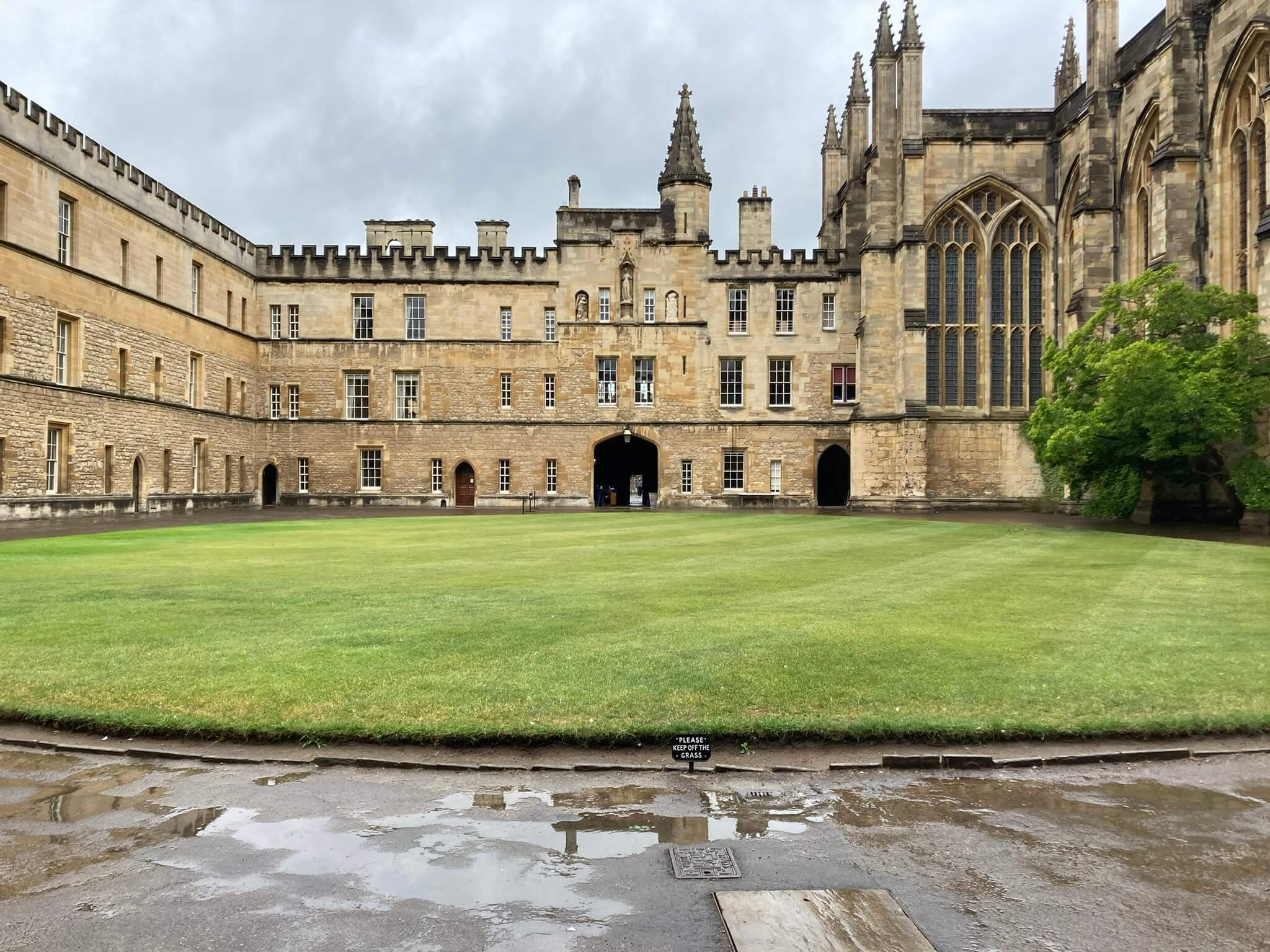
We ventured into New College, famous for the immaculate green lawn in the centre yard and cloistered corridors.

The rest of the tour, we explored the streets of Oxford, passing by several colleges, including Exeter College where Tolkien supposedly was inspired to write the Hobbit and Lord of the Rings. We also passed by the Radcliffe Camera (library) and saw the Bridge of Sighs.

Oxford Accessibility
The main streets and foot paths are bitumen/concrete with good curb cutouts and road crossings.
Moving away from the main streets, there were a lot of cobblestones! Some of the cobblestones were among the roughest I’ve had the joy of driving over. Footpaths in these areas were narrow and bumpy.

In New College, the surface was a lot smoother, with more concrete and modern paving. I was surprised by how accessible the college was, with ramps into the chapel and other areas, as well as hidden elevators near the kitchen to get up to the dining hall – this was a good example of accessibility without impacting heritage buildings.

The biggest barrier on the day for us was the weather. For our entire tour, there was torrential rain. We didn’t have an umbrella, but I did have a poncho and semi weatherproof blanket to cover me.
My electric wheelchair doesn’t like to get wet, so we covered my electrical controls with a Ziploc bag. At one point, the rain was so heavy that my chair came up with an “I’m too wet” error and stopped. Thankfully, I was able to get under the Bridge of Sighs to dry the electrics and keep going.

Wherever possible, we headed inside to avoid the rain, however there are a lot of outdoor areas in Oxford without covering that meant we were pretty soggy by the end of the tour.
Although we didn’t visit many shops, some appeared to have some steps. The Bodleian library café was a good place to find an accessible toilet and some nice cakes.
There was some disabled parking in the centre of town we were able to use.
Cambridge
I knew a lot less about Cambridge before I visited, so I was interested to see how it differed from Oxford.
For some reason, I expected the Cambridge CBD to be modern, high-rise buildings, with some older university buildings scattered around. However, I was very surprised to find out that Cambridge was the complete opposite – beautiful historical buildings, where shops and businesses blend in with the old architecture.

Cambridge felt a bit less dense and more spread out than Oxford, with more parkland in the centre of town and the river Cam passing through the back of many colleges.

Just like Oxford, Cambridge has colleges scattered among the town, with certain tours gaining you access into some colleges. Students are enrolled in colleges and have similar tuition structures as Oxford.
Cambridge walking tour
We booked a 90-minute group walking tour of Cambridge with Cambridge alumni tours.
Our group had about 15 people, with some families, couples, and us. It was a good size to be able to follow and hear the guide without feeling overcrowded.
Our guide was a Cambridge music student who gave us great insights into student life and the history of Cambridge.
Our tour started outside of King’s College Chapel, a beautiful building in the centre of Cambridge. Unfortunately, the chapel was closed on the day we visited due to a private event.

Along the way, we saw the Corpus Christi clock, a slightly creepy golden clock that features a grasshopper eating away time. At the end of each hour, the sound of chains dropping onto a coffin goes out remind everyone of their fading mortality.

We visited some other chapels and passed several colleges, before wandering around the “backs”, the areas along the back of main colleges such as King’s College. This is where the River Cam runs.

Along the river, we saw people punting (gondola style boats propelled by someone digging a giant pole into the riverbed). If you look like a tourist, expect to be commandeered by young, athletic-looking Cambridge students trying to get you to book a punting ride. Unfortunately, these are not accessible.

After our tour, we stopped at a pub for a Sunday lunch roast, followed by a stroll through Parker’s Piece Park and the Cambridge market area (this was overrated in my opinion). Finally, we enjoyed some ice cream and exploring bookstores.

Cambridge accessibility
Cambridge is bit more spread out than Oxford. The centre of town is still reasonably small and very walkable/wheelable. However, there are more outer suburbs – we stayed at Eddington, a new modern suburb with stylish apartments, restaurants, and a few key amenities.
Cambridge is designed as a pedestrian town. We visited on a Sunday, and the roads were closed to vehicles most of the day due to a fun run. If you do drive into town, we did see a lot of disabled parking spaces. However, we used a park-and-ride bus service which worked great.
Being an older town, Cambridge has cobblestones. These didn’t feel as rough as Oxford and weren’t as widespread. Paths often had paving and were a little narrow in places, especially with tourist crowds on bridges, so wherever possible I just drove on the road since there were no cars around.

Along the river, the backs had a gravel pathway which was a bit rough in sections. At times, I found it smoother just to drive along the grass. Closer to the centre of the town, there were some boardwalk pathways to get along the river a fair distance.

Oxford versus Cambridge: The verdict?
Which I preferred?
Although there are a lot of similarities between Oxford and Cambridge, they felt very different. However, despite the weather, Oxford was the winner for me.
Oxford felt smaller, darker, and more mysterious. That might have just been the awful weather, but I think the darker buildings and colleges hidden behind high walls made the town feel older and more intriguing.

Cambridge on the other hand felt larger, more open, slightly more modern, and lighter. Again, the beautiful sunny day probably had something to do with that. However, the lighter colour buildings and wider streets and parkland definitely contributed.
I found Oxford to be a little bit more interesting, in terms of the history, famous former students, and Harry Potter locations.
In my opinion, Oxford was also prettier, with beautiful architecture and immaculate college grounds. Cambridge on the other hand looked a bit wilder, with more mismatching architecture and parks with long grass and wildflowers.

I’m not sure if the weather or the day we visited Oxford and Cambridge impacted visitor numbers. However, visiting Oxford on a rainy Thursday was very quiet. There were certainly people wandering around, but it didn’t feel touristy at all.
Visiting Cambridge on a sunny Sunday on the other hand was busy – there seemed to be more of the big bus tour groups (you know, the large tour groups with the person holding the flag at the front). Streets were quite crowded, with a lot of people standing on the bridges or congregating outside the main attractions. It also felt more commercialised, with more tour guides and punting captains trying to get people to take their tours.

Which was more accessible?
Both and Cambridge had their fair share of cobblestones, but the cobblestones were definitely much more epic in Oxford.
The main streets of both were reasonably accessible, with more modern pavements. Cambridge being a little bit more modern, was probably a little bit more wheelchair friendly and smoother overall.
We didn’t venture into any colleges at Cambridge sure how they rate on accessibility. However, I thought the accessibility in the Oxford colleges we visited was very good.
Which should you visit?
If you are going for history, architecture, or Harry Potter – Oxford should be your priority.
If you are looking for a more relaxed experience where you can just wander the town and experienced some nice outdoor areas – Cambridge should be your priority.
However, if you have the time, I recommend you visit both. They give very different experiences and have a different feel. I enjoyed both, just in different ways.
Ratings
Wow Factor: Oxford = 4/5, Cambridge = 3/5
Cobble index: Oxford = 2/5, Cambridge = 3.5/5
Barrier free barometer: Oxford = 3.5/5, Cambridge 3.5/5
Want more?
Don’t forget to subscribe below to receive email notifications when new blog posts are released. You can also check out the following related articles:
Escape to the country: Exploring the Cotswolds in a wheelchair
Bath in a wheelchair: from Roman baths to Jane Austen
A wheelchair friendly self drive road trip in the UK and Ireland