
When we planned our four-week trip to the UK and Ireland in June 2025, we knew that basing ourselves in London, Dublin, and Edinburgh and relying on public transport was not for us. The UK/Ireland that I wanted to see was the cute villages, country lanes and castles on the hill (thanks Ed Sheeran), rocky beaches, and dramatic clifftop views.
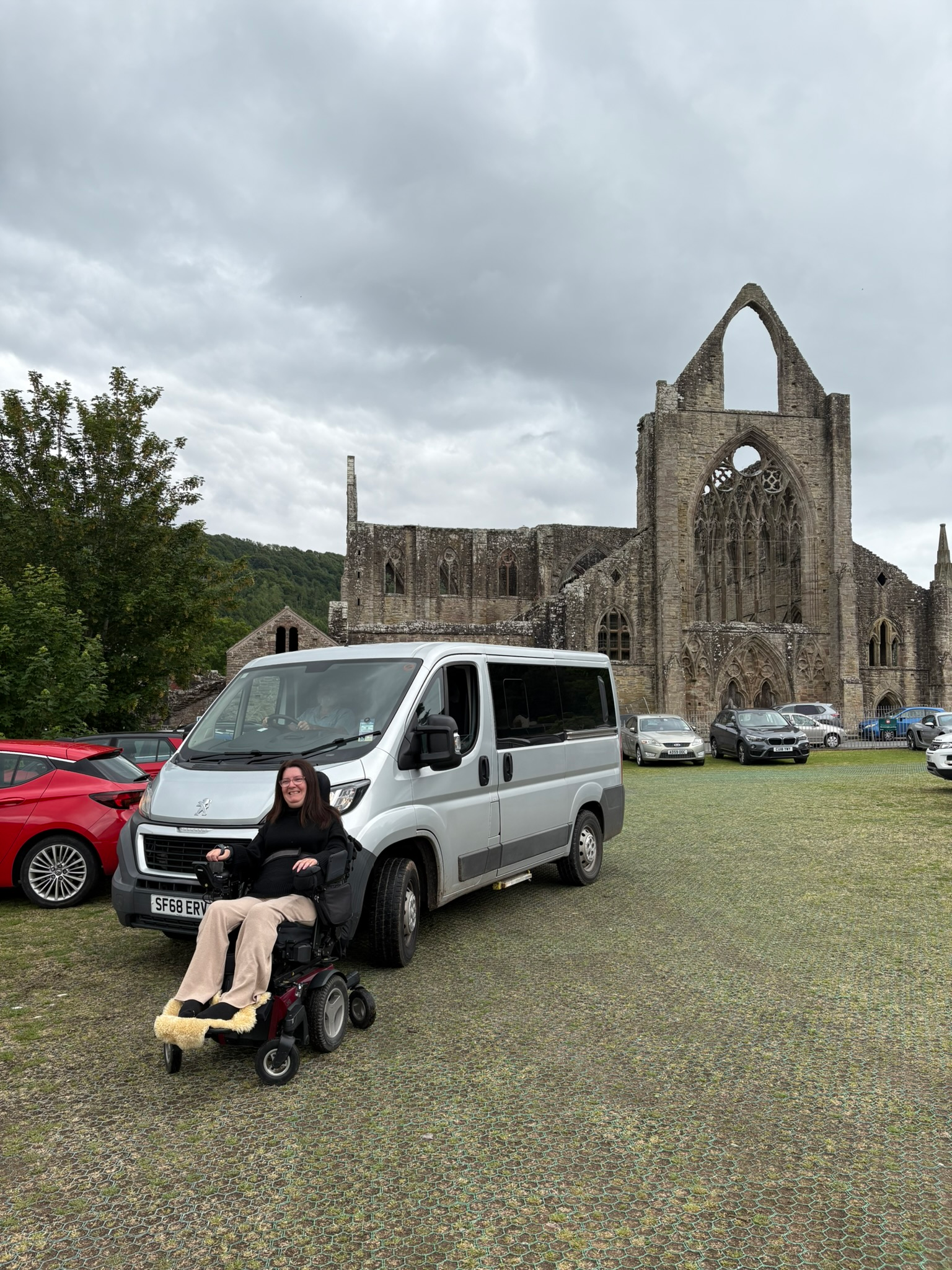
We designed a slow, wheelchair accessible, self-drive road trip in the UK and Ireland, passing through England, Wales, Ireland and Scotland. Hiring a wheelchair accessible vehicle gave us independence, flexibility, and access to places off the beaten track. This allowed us to experience much more than we would have it we had stayed in the big cities and relied on public transport.
Why a road trip approach worked better for us?
The UK has an excellent public transport system, and we happily used trains, buses, and trams within London, Dublin, and Edinburgh. However, travelling between and beyond these cities presented some accessibility challenges for us:
- Narrow bodied aircraft travelling within the UK/Ireland are too small to accommodate my large power wheelchair.
- Bus tours are not accessible for power wheelchairs.
- We travel with A LOT of luggage and equipment, which usually exceeds luggage limits.
- Hauling our luggage on and off trains and buses can be difficult.
- Reaching rural destinations would have required multiple accessible taxi bookings, which are expensive and not easy to find.
A self-drive road trip gave us control. If we saw something we wanted to stop and look at, we stopped. If we needed a bathroom or food break, we could.

On our road trip, we took motorways for longer and less scenic stretches only. Most of the time, we prioritised smaller highways or scenic regional roads.

The drive itself is also a time to relax. We enjoy watching the scenery shift from sandy beaches to mountain passes and driving through quiet little towns. There is the opportunity to take a nap, listen to an audiobook music, or podcast. On our UK road trip, I learned basic French (surprising my travel companions when I could suddenly speak French as we entered France from the UK).
Our road trip route at a glance
Over 27 days, we covered approximately 3000 km (1900 miles) across England, Wales, Ireland, and Scotland.

We hired a wheelchair vehicle from Open Road Access (ORA) for our road trip. We nicknamed our vehicle “Peggy the Peugeot”.

Starting in London, we travelled west to the Cotswolds, exploring nearby villages and making day trips to Oxford and Bath. From there, we took a scenic drive through the Forest of Dean and Wye Valley to the Welsh coast at Tenby.

After taking the ferry over to southern Ireland, we based ourselves in Naas for a week to attend a conference, with day trips to nearby Dublin and the Wicklow mountains. We continued south through Kilkenny and the Rock of Cashel to Killarney, where we explored the Ring of Kerry and Dingle peninsula before heading north along the Wild Atlantic Way.

Returning East across Ireland, we caught a ferry across to northern Wales, before spending a few days in the English Lake District. Heading north into Scotland, we spent a few days exploring Glasgow, Stirling, Edinburgh, and the Trossachs.

We completed our road trip with a stop at Cambridge before boarding the ferry France at Dover.
Our slow and strategic travel philosophy
My travel philosophy is a mix of slow travel and strategic accessibility.
We aim to spend multiple nights in each base location, allowing time to immerse ourselves in local, food, culture and scenery, rather than rushing through a checklist of tourist attractions. We like to eat and stay local wherever possible, to support local businesses.
People often comment how much we fit into our road trips. This is because we carefully plan to manage our energy. We balance busy exploration days (attractions, tours, nature strolls) and longer driving days with restful days (massages, wandering through villages). This reduces fatigue and makes our road trips sustainable.

Accessible accommodation and vehicle hire require advance booking. However, we also build flexibility into our days. Before travelling, I research multiple route and activity options in case we need to adjust for weather or energy levels. For example, in the Lake District, when it rained, we replaced hiking with scenic drives, massages, and afternoon tea activities.
Where we stay on road trips
Wherever possible, we aimed for multi-night stays in cottages or vacation homes. This minimised packing and unpacking.
These properties had at least 2 bedrooms and bathrooms, kitchen, laundry facilities, and free parking. This gave us more space to store luggage, have some “me time”, and provided a lot of convenience and cost savings. There was often a cozy fireplace to relax with a cheese platter in the evenings.


We stocked up at local supermarkets (which is fun in itself exploring international supermarkets) and had a portable cooler bag with ice bricks to carry food between each destination. This allowed us to have some home-cooked meals when we needed a break from eating out. Having a microwave was also very important for me for my heat packs.

Having a laundry was convenient – we put on a load of washing on at night or while we were out on day trips – saving time and money on coin laundromats.
Not all of the cottages/homes we stayed at were fully wheelchair accessible. Some had a step at the front door which we used a portable ramp to access. As long as they had a roll-in shower with shower hose and I could access the bedrooms (using bed lifters for my hoyer lifit to fit under) that was sufficient for our accessibility requirements.

Final reflections
For us, the driving was not just about getting from A to B. It was a deliberate way of travelling that prioritised independence, energy management, and connection to landscapes and local culture. This strategy has not only worked in the UK/Ireland, we’ve done similar road trips in the US, Australia, and Europe, that have all been incredible.
Slow and strategic travel is not about doing less. It’s about designing a journey that works with your needs. For wheelchair travellers seeking flexibility and access to rural beauty, our self-drive approach permits you to experience more than just capital cities.
Want more?
Make sure you subscribe to the blog (sign up below to receive an email notification whenever a new post is published) and follow my social media for more information on destinations in our UK and Ireland road trip.
https://www.instagram.com/chair_went_there
https://www.facebook.com/chairwentthere
Don’t forget to check out previous posts on London, including how