
Changi Airport is Singapore’s international airport. In addition to being one of the world’s busiest stopover airports, the airport is a tourist attraction in itself.
We have stayed at and flown through Changi several times. Read on to find out my perspective on wheelchair access, things to do, accommodation and transport options.
About Changi Airport
The airport is around 15km from the main part of Singapore city.
Changi Airport has 4 terminals:
- Terminal 1 hosts major international carriers such as Qantas and Emirates.
- Terminal 2 generally handles regional flights.
- Terminal 3 is the main hub for Singapore airlines. As we have flown Singapore airlines, this is the terminal I have used each time.
These terminals are all interconnected by the new Jewel entertainment complex.

Terminal 4 is separate from the others, but accessible by shuttle bus. This terminal is mostly for low-cost and regional flights.
Terminal 5 is currently being built and is expected to be ready in the early 2030s.
Things to do at Changi Airport
There is plenty to see and do if you have some extra time to spare while passing through Changi Airport. You can go swimming, visited a spa, watch a movie, or even get married if you want.
Within the terminals, there are several nice gardens to explore.
Terminal 3 has an indoor butterfly garden hosting over 1000 butterflies and a 6-metre waterfall. As someone with a lifelong butterfly phobia, I chose not to venture inside.


The Jewel
On our most recent 24-hour Singapore stopover, we spent a few hours exploring the Jewel complex. We entered via the pedestrian bridge from Terminal 3, which had some travelators to help you along the 1-2km walkways.

The Jewel is shaped like a giant doughnut and has 5 levels above ground, and 5 basement levels. At the centre of the building, we spotted the Jewel Vortex, which is a 40-metre indoor waterfall surrounded by beautiful gardens.

Elevators take you to various viewing points.

At the base of the waterfall, we got our photos in front of the waterfall and spent some time relaxing in the gardens with the misty spray from the waterfall keeping us cool.

Aside from the waterfall, we explored shops. There is also a food court, movie theatre, and some other interactive activities (e.g., some simulator/interactive airport-style activities).

Accommodation and transport options
If you want to stay overnight, or have a few hours’ sleep at the airport, there were a couple of options.
On our most recent 24-hour stopover, we stayed at the Crowne Plaza hotel, which is located inside Terminal 3. See my related post for a full review. This is the best place to stay if you are looking for a wheelchair accessible room at the airport.


There are also some smaller transit hotels (Yotelair, Aerotel, Ambassador). These tend to be smaller, modular style rooms most suited for getting a few hours’ sleep, and probably not large enough to comfortably accommodate a wheelchair.
To get between terminals and the Jewel, there are pedestrian bridges. There is also the Skytrain that connects the terminals. The Skytrain is worth just taking a ride on because it goes under/through the Jewel Vortex waterfall.

There are several transport options to get from the airport into the city.
The Changi MRT is located under Terminal 3. This will get you into the city in around 30 minutes, with 1 or 2 interchanges along the way.
Accessible taxis are available, but I would recommend booking as they don’t seem to be waiting in taxi ranks. Accessible buses can be found at the bus terminal.
It’s also worth noting that public transport shuts down between midnight and 5:30 AM. Read my blog on accessible transport options in Singapore for more information, including how we got stuck at the airport.
Flying in/out of Changi Airport as a wheelchair user
Departing Singapore
We have now had 4 stopovers in Singapore. Each time, we have flown Singapore airlines so have only used Terminal 3.
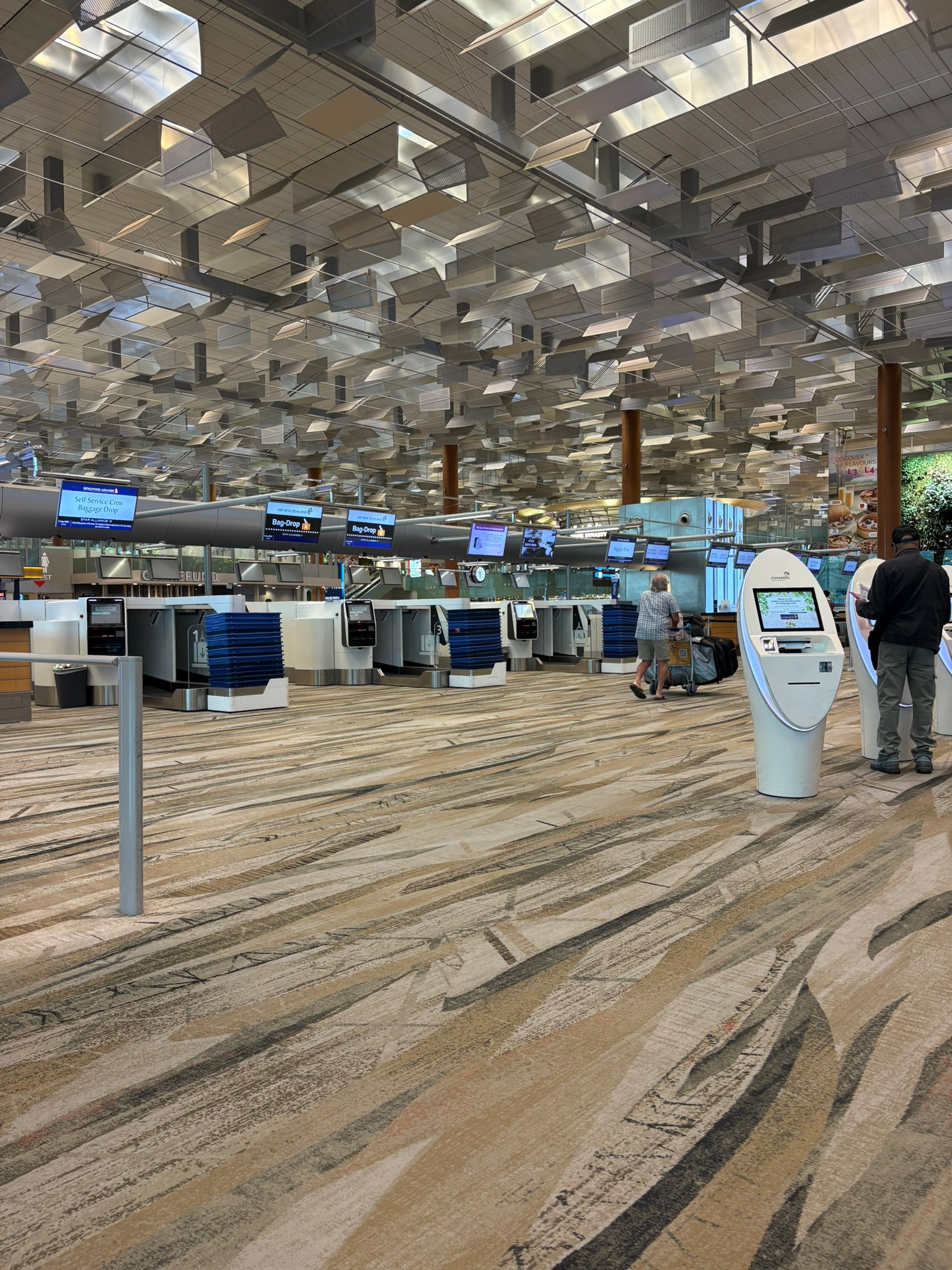
Terminal 3 has a huge departure hall, with lofty ceilings and lots of space between check-in counters. There are some automated check-in counters, however when playing with a wheelchair, we always need to visit the humans at the check-in counter.

There is not much else in the check-in hall, other than a duty-free shop, a Singaporean cake shop (where I like to stock up on pandan cake before returning to Australia), and some toilets. If you are looking for more food and retail, you either need to go through customs, visit the Jewel, or go down to the Arrivals floor.
Once we check-in, we go straight through customs for passport checks. Usually this is pretty quick, we’ve never had a lineup.
Inside the secure area, there is the obligatory duty-free shopping, expensive luxury stores, and overpriced general stores selling travel pillows, snacks, and books.
There were a few takeaway stores on the main level, however we generally catch the elevator up to the mezzanine. Here, there is a Burger King, 7-11 an Asian food court. There is much more seating at this level as well.
Next, we headed towards the gate. Unlike other airports I visited, this is where security is located. That is, you go through the security scanners then there is the gate seating area. There are some toilets within the gate, and a little snack store in some gates, but not much else.
Important accessibility info for departures
In terms of accessibility for wheelchairs, there’s a couple of things to be aware of.
First, the aisle chairs (a narrow chair that fits down the aisle of the aeroplane you are transferred into when boarding) are not supportive. They have a low back and only a strap around the waist/chest to hold you in.
With minimal upper-body balance, I find these chairs extremely uncomfortable and dangerous. We use an extra Velcro strap around my shoulders for support, but even then someone has to hold me upright.

Liv pretending that everything is fine.
Second, terminal 3 does not have elevators at gates to take the wheelchair to the cargo-hold. Mind-boggling considering they can build a 40-metre indoor waterfall at the airport.
Therefore, airport staff want me to transfer out of my own wheelchair as early as possible (at check-in 2-hours before boarding) to give them time to take my wheelchair down to the cargo hold. This is not possible for me due to pain and injury risk.
Therefore, every check-in, we enter a long negotiation with staff about remaining in my wheelchair as close to boarding as possible. They always tell us: “it’s not possible”.
It is absolutely possible! I have remained in my wheelchair to the gate on multiple occasions and was even allowed to board in the air bridge.

When I have transferred to the aisle chair at the gate, it’s not a great experience. Not only comfort-wise sitting in the aisle chair for 10+minutes, but because I am manually lifted in front of 400+ staring passengers.
Arriving in Singapore
Like any airport, wheelchair users are always the last of the plane while the wheelchair is retrieved from the cargo hold.
At some airports, your chair will be brought to the door of the aircraft. At Changi, because they don’t have the elevator, they refuse to bring the wheelchair to the door of the plane.
The wheelchair is loaded onto a little trailer behind a golf cart and delivered the loading dock near the terminal security area. I am loaded into the aisle chair and wheeled through the arrival gates, down an elevator, to the loading area, where I am reunited with my power wheelchair.

Once back in my own comfortable wheelchair, I am escorted through customs. They now have an automated system, where you scan your passport, sit/stand in front of the camera, and are fingerprinted. The customs staff usually bypass the fingerprint stage for me, as I can’t splay out my fingers on the display.
For some reason, the cameras in these booths and never recognise me. So, I’ve always ended up being taken to the administration area, where they have a lower desk and camera for my photo to be taken.
In my experience, the arrival staff always been very lovely and helpful.
After clearing customs, it is out to the arrival hall, to either go to the airport hotel or transport. These are all accessible via the Terminal 3 building.
Verdict
It is worth passing through Singapore airport at least once, either spending a few hours exploring on a stopover, or staying over for a couple of nights to explore Singapore city as well.
Not only is staying at the airport convenient, but the airport is very accessible to get around and into the city. You don’t even have to leave the airport to find something interesting to see/do.
As mentioned, there are a few things to be aware of as a wheelchair user flying in and out of Singapore. My experiences only relate to Terminal 3 though, so I can’t comment on accessibility in the other terminals.
Want more?
Don’t forget to check out my other Singapore accessibility guides:
Singapore highlights: how to see Singapore in a wheelchair
Gardens by the Bay accessibility guide
Singapore accessible transport options
Singapore Hawker Centres: accessible places to eat in Singapore
Singapore neighbourhood guide: The best accessible areas to stay
Singapore hotel guide and reviews
Unique accessible outdoor places to visit in Singapore
The Accessible Singapore website also has plenty more information to help you plan your accessible stay in Singapore.
Disclaimer
All opinions expressed in this blog are my own and all reviews are non-solicited.
I understand that every disability is different, and what works for me may not work for everyone – it’s important to do your own research on any destination or accommodation to make sure that it meets your accessibility requirements.
Leave a Reply