
Bath is an elegant little city located in the South-West of England. Recognised as a UNESCO world Heritage site, Bath is famous for Roman baths, a mediaeval abbey, Georgian architecture including the Royal Crescent, Jane Austen, and more recently Bridgerton.
Read on to find out about our favourite places in Bath, as well as tips for visiting Bath in a wheelchair.
Our walking tour of Bath
We did a half-day private walking tour of Bath with Bath Walking Tours. We loved the private tour, as it was designed entirely around our interests – city highlights including the Roman Baths, Jane Austen, Georgian architecture, Bridgerton, and visiting pretty locations.
Our guide was Jim, a registered Blue Badge tour guide (in the UK, the Blue Badge is the highest qualification for tour guides). Jim was a fantastic tour guide! He had a warm and friendly demeanour that made you feel instantly comfortable. He was also full of interesting historical facts and funny stories, including stories of his previous tours with international Royal families.
All Bath Walking Tours are fully wheelchair accessible. Jim was extremely good at identifying accessible pathways for my wheelchair.
Unfortunately, the weather was not great when we visited Bath, with several heavy rain showers. Thankfully, Jim adjusted our itinerary on the day to keep us dry and warm.
Roman baths
Our first Bath attraction was the Roman Baths.
Before visiting, I knew almost nothing about the Baths. I did not expect to enjoy them as much as I did!

The Roman baths, also known as the Aquae Sulis date back to the 1st century, when the ancient Romans discovered natural springs at the side.
Considering the baths were built over 2000 years ago, the archaeologists have done an amazing job of preserving the site. Our tour took us around the Great Bath, Sacred Spring, Bath House Rooms, and the Pump Room.
The Terrace, Great Bath, and Sacred Spring
The Great Bath is quite impressive. We started at the Terrace, an outdoor balcony lined with Victorian statues. From the Terrace we had a great view down over the Great Bath, city rooftops, and across to Bath Abbey nearby.

Next, we wandered around the edge of the Great Bath. This steaming hot spring is surrounded by beautiful old columns and is about 1.5 m deep.


While the ancient Romans used the baths for their health, nowadays we know that the Bath is lined with toxic lead, which means no more swimming. Although, that hasn’t stopped many partygoers and university students from having a sneaky swim over the years.
Next, we wandered around The Sacred Spring, which the Romans believed were blessed by the goddess Sulis Minerva. Here, you could feel the steam coming off the 46° Celsius pool.

Probably the most interesting part of this area was the ancient Roman plumbing that is still working. We traversed glass walkways that allowed you to look down into the old drains carrying spring water from underground into the bathhouse.

Inside the bathhouse
Inside the bathhouse, there are several museum exhibits. As someone who is not normally a museum person and someone who knew very little about the history of Bath, I surprisingly found this part of the tour very interesting!

The museum included archaeological digs with parts of the ancient temple that had been found, a huge collection of ancient coins, as well as jewellery, and ornate cutlery and crockery. I was particularly intrigued to see old tweezers and nail clippers – even the ancient Romans were going to beauty spas to get their eyebrows and nails done!

Inside the bathhouse, which actually runs under the city streets, we toured through change rooms and indoor pools. Cold plunges and saunas are the latest trend these days but it turns out the ancient Romans were doing these things 2000 years ago.
The pump room
Finally, we visited the Pump Room. This much newer building (late 1700s) was designed as a social place to get together and drink the healing spa waters. Historically, this building has been home to Bath’s biggest social events, with guests including Jane Austen, which inspired scenes from my 2 favourite Jane Austen novels: Persuasion and Northanger Abbey.

The Pump Room is a beautiful, large room with glittering chandeliers where you can enjoy afternoon high tea with classical musicians playing in the background. We didn’t stay for tea, but the room itself was worth a visit.
The main reason Jim took us to the Pump Room was because to this day, you can still drink the spring water that is apparently full of minerals straight from the fountain.

Of course, we all sampled the mineral spring water. In case you’re wondering, it tasted like plain old warm water.

Accessibility at the Roman baths
The Roman Bath website has excellent information about accessibility for wheelchairs, neurodiverse visitors, people with dementia, hearing and visual impairments, and people who experience claustrophobia – some of the indoor areas are dark and feel closed in.
Companions receive free entry to the baths.
There is flat ground level access into the main foyer/ticketing area, pump room, and outdoor terrace. Inside, there are several elevators. This includes an enclosed elevator just outside the main foyer that fit me in my large power wheelchair and 2 others snugly.
There were also 3 platform lifts which are even smaller and had lower weight limits. On these, there was too much weight with my wheelchair plus Jim, so I rode these alone with Jim and my carer using the exterior controls.
Being nearly 2000 years old, there are some ancient, paved areas that are a little bit rough for the wheelchair. But… It is 2000 years old, so I’m okay to compromise comfort to experience such incredible history.
I found the surface around the Great Bath and Sacred Spring a bit tricky – there were huge stones with big holes, I had to be careful my wheels didn’t fall into the holes.

Inside the museum, there were much smoother pathways and some ramps where the ground level changed. There are several sections of glass flooring that allow you to see into the Roman drains, these were fine for the wheelchair.

If anything, the biggest barrier was navigating through crowds on a busy Saturday, however Jim did a great job of clearing the way for me to get up close to the exhibits.
Bath Abbey
Our tour didn’t originally include Bath Abbey, but as it was bucketing down rain as we left the Baths, we took a detour into the Abbey next door to escape the rain.

We spent about half an hour just wandering around the Abbey. The Abbey is quite beautiful, with high vaulted ceilings and a wall made almost entirely of stained-glass. Unlike some other cathedrals I have visited, this was comparatively light and bright.

Another point of interest in the Abbey were the war memorials and ledgers throughout. It was interesting to read the plaques, while Jim told us about the history of the Abbey.
The Abbey is fully wheelchair accessible, with flat entry access and floors.
Central Bath
Still raining cats and dogs, we headed to the nearby Brown’s Brasserie and Bar for lunch.
OMG the food was delicious! I had crispy pork belly with seared scallops – my 2 favourite meals combined in one dish! My carer who is a vegetarian, loved her roasted cauliflower. My parents had pasta and thoroughly enjoyed their meals.
While we ate, Jim entertained us with more stories and pointed out some attractions out the window, including the river and Pulteney Bridge, one of only a handful of bridges in the world to have shop stalls along the bridge.

Once the rain finally stopped, we were able to get outside and stroll through the streets of Bath. In among the beautiful old architecture, there are some main shopping areas where you will see all the big brands.

Instead, Jim took us through some of the prettier areas of the city and pointed out some off the beaten track attractions, as well as a couple of Bridgerton filming sites including the Abbey deli on Abbey green (a.k.a. the Modiste).

The Royal Crescent
After exploring the central areas of Bath, we headed uphill to the Royal Crescent. Bath, interestingly, is surrounded by hills. Jim mentioned that if you ever get lost and need to get back to the city, you head downhill.
On our way up the hill, we wandered through some lovely parks and admired the beautiful Georgian architecture.

The Royal Crescent is probably one of the more known/photographed parts of Bath. This Crescent-shaped row of terraced houses is full of old-world charm and elegance. You could just imagine old carriages with ladies dressed in their finery pulling up along the Crescent.
Many years ago, the resident of one of the rebelled and painted her door bright yellow instead of the traditional white. Jim told us about the many legal cases, which the resident won, that has led to the yellow door becoming an icon.
We weren’t able to get too close to the Royal Crescent on the day, as the area was closed off for a Robbie Williams concert – not a bad place for a concert!

The Circus
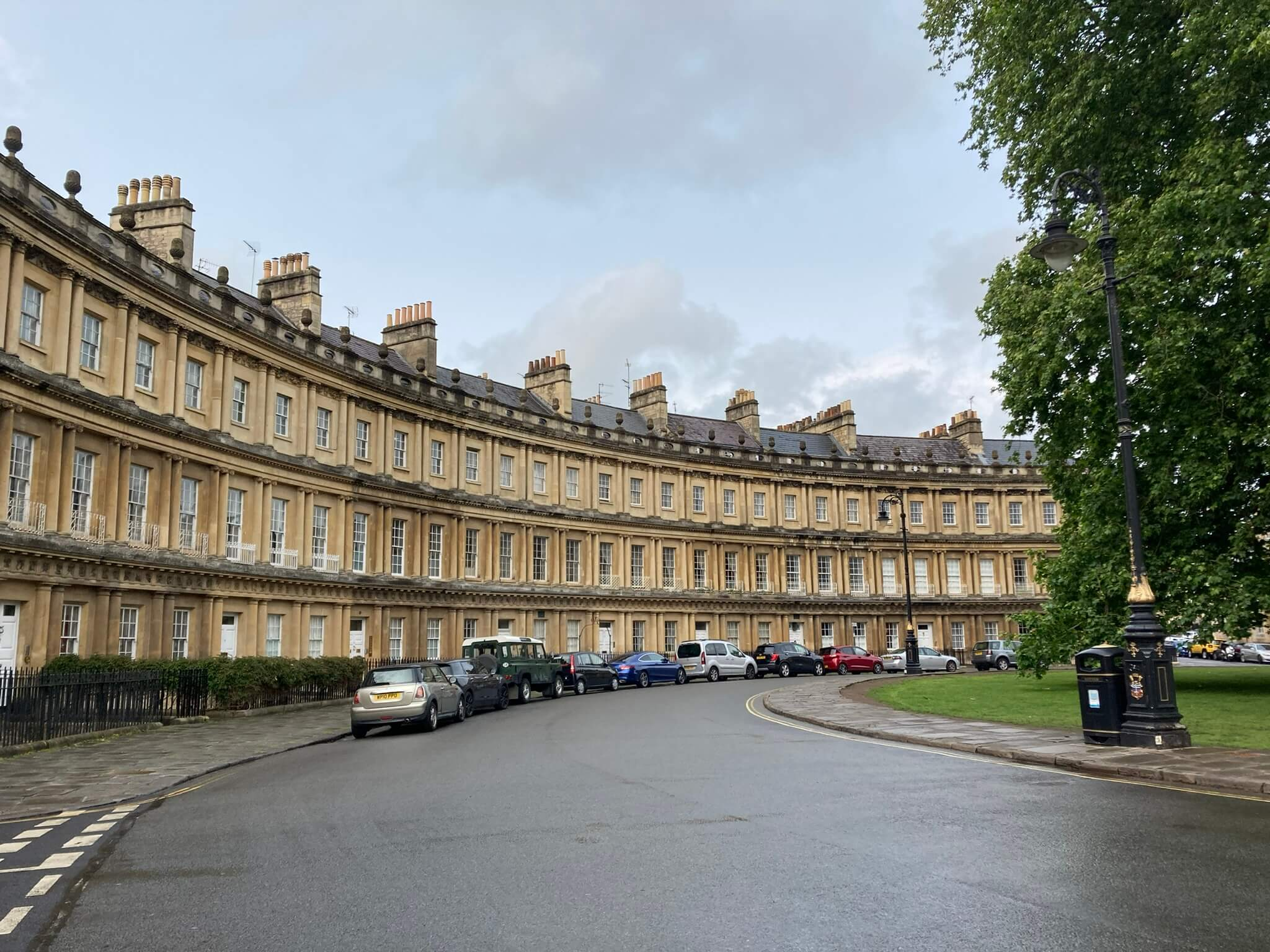
Next, we headed back down the hill a little towards the Circus. This is a street area shaped in a circuit, with 3 sections of rounded architecturally designed houses surrounding it.

Jim told us some great stories about a former resident of the Circus, actor Nicholas Cage. Nicholas owned 2 properties in Bath – a castle that happened to be next door to Jim’s property, which resulted in Nicholas one day randomly popping into Jim’s for coffee.
Nicolas Cage’s other property was number 7 The Circus. However, Jim pointed out to us that there was no number 7 on the door. Apparently, Nicholas became sick of people in front of his home, so his solution was to remove the number.
Jim also told us about a previous client who requested a tour based around boot scrapers at front doors – for the rest of the tour we found ourselves pointing out boot scrapers, they were more interesting than you would think!

Visiting Bath in a wheelchair: Accessibility tips
The main attractions at Bath, the Roman Baths and Bath Abbey, were very accessible for wheelchairs.
Many foot paths/pedestrian areas in Bath are paved, with a few rough areas in the older parts of town.

Heading up the hill to the Royal Crescent, the incline was okay for me in my power wheelchair but might be more difficult for people in manual wheelchairs. I found the cutouts of the curbs pretty good, with only a few where we needed to take a minor detour to cross the road.
Tips for visiting Bath
Bath is an old city with a lot of pedestrian areas. It is very walkable/wheelable with only short distances between the main attractions.
There is some parking in Central Bath, including in the Southgate Shopping Centre. However, there are height restrictions which meant our van would not fit.
I highly recommend using the Lansdown park-and-ride, which is a cheap, easy, and stress-free way to access Bath. The parking area is located about 10-minutes outside of Bath, with around 800 outdoor parking spaces available. There is a shuttle bus that is fully wheelchair accessible that runs regularly to drop you off and pick you up in the centre of Bath.
The Roman Baths do get quite busy on a weekend, which was unavoidable in our itinerary, but if you can visit on other days, I would recommend that. Although it was busy, it wasn’t enough to impact our tour, but might have been a bit more pleasant with fewer people.
Overall Impressions
I really enjoyed Bath. It had a very relaxed vibe, where you felt you could just wander the streets for hours and admire the beautiful buildings.
As a Jane Austen and Bridgerton fan, I loved being able to see some of the book and filming locations and experience the Royal Crescent.
The Roman Baths were surprisingly a highlight. Jim’s tales about the history and archaeology were fascinating.
Ratings
Wow Factor: 5/5 – Bath is beautiful to visit and has such a cool history.
Cobble index: 3/5 – Some rough sections of pavement, but given it is a historical location, it was nice to have the authentic paving and stones, especially in the Baths.
Barrier free barometer: 4.5/5 – The city is quite accessible. The Roman Baths have done an incredible job of making something that is 2000 years old accessible! Some of the platform lifts could have been a little bigger but otherwise well done!
Want more?
Check out related posts on visiting England in a wheelchair:
Wheelchair friendly self drive road trip in the UK and Ireland