
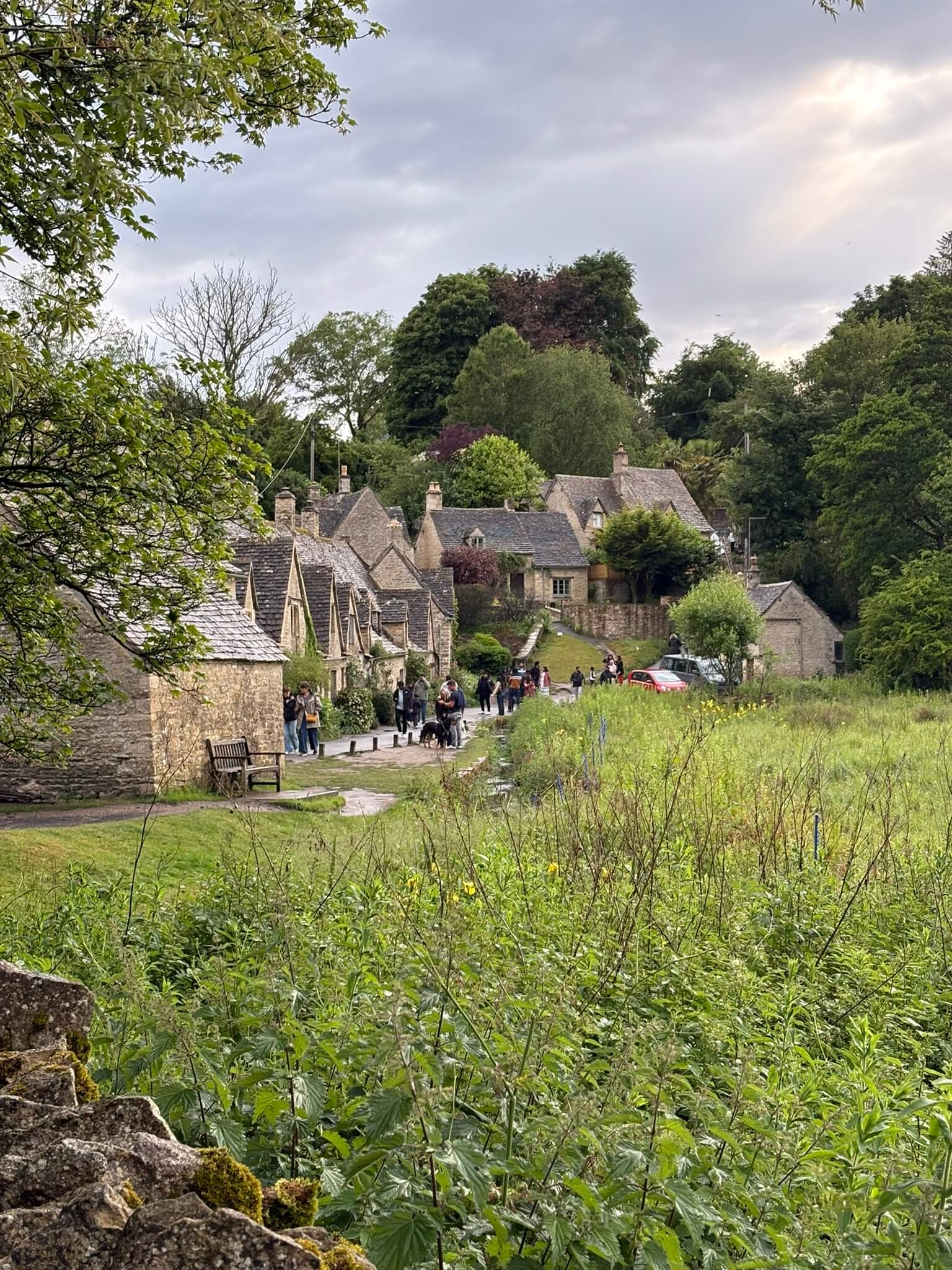
The Cotswolds has been on my bucket list for a long time – and they absolutely did not disappoint! Staying on a quiet country estate, we wandered through quintessential fairy tale villages, rambled through the countryside, experienced scenic drives down country lanes, and tasted delicious local produce.
Read on to find out about our favourite places in the Cotswolds, practical advice, and accessibility tips for visiting the Cotswolds in a wheelchair, as well as my review of our accessible barn at Notgrove Holidays.
About the Cotswolds
The Cotswolds is a regional area in south-west England, about 2 hours’ drive west of London.
The Cotswolds is recognised as a National Landscape (formerly called Area of Outstanding Natural Beauty (AONB). This means it is an exceptionally pretty area that is protected by law for conservation.

The region covers over 800 square miles and is made up of over 100 towns and villages.
There is a lot to see and do in the Cotswolds, including castles and country Manor homes, wildlife parks, museums, tearooms, and more.
Our itinerary
We chose to go with a slower-paced itinerary, spending time in just a few select villages (see recent post about our slow and strategic road trip philosophy and full UK/Ireland road trip itinerary). This itinerary for visiting the Cotswolds in a wheelchair allowed us to spend more time out of the car wandering through picturesque villages and exploring the countryside.

Overall, we spent 3 nights in the Cotswolds, basing ourselves at Notgrove Holidays/Estate, in the middle of the Cotswolds, near Northleach and Bourton on the Water.
We separated our day trips into northern and southern Cotswolds regions.
Our northern Cotswolds scenic road trip took us along quiet country lanes bordered by rock hedged walls, under tree canopy-lined roads, and through quintessential villages such as Snowshill. We stopped to spend some time in Bourton on the Water, Upper and Lower Slaughter, Stow-on-the-Wold, and Broadway.

Our southern Cotswolds’ road trip took us through country fields and villages, and down to Bath (see my latest post on Bath).
Read on to find out more about our favourite places to visit in the Cotswolds.
Bourton on the Water
Bourton on the Water is known as the “Venice of the Cotswolds” due to the River Windrush flowing through the middle of town with little stone bridge crossings.

I’m normally not a fan of places brimming with tourists. However, this one was worth it. As it is known to be crowded through the day, we visited in the evening and almost had the town to ourselves.
We enjoyed a lovely stroll along the river and through the streets of honey-coloured limestone homes and shops, before a delicious meal at a small pub where we chatted to some locals.

.
Bourton on the Water has several attractions for daytime visitors, but we chose to skip these. There is the Cotswolds model village, but as it is not wheelchair accessible, we did not visit. There is a dragonfly maze and also wildlife park that are great for kids.
Another attraction is the Cotswolds Motoring Museum and Toy Collection. I’m not a museum or motoring enthusiast, however was contemplating visiting, purely because I was a fan of the 1990s BBC TV series “Brum”, and this is where the little car lives. For anyone interested in visiting the museum, it is disability and neurodiversity friendly.

Upper and Lower Slaughter
I’m sure that when you hear that I visited Upper and Lower Slaughter, that I must have been visiting villages famous for abattoirs or violent murders. Thankfully, the name slaughter has nothing to do with mass killings.
Instead, is based on an old English word meaning “muddy place”. Although, that doesn’t sound much more appealing, does it? Thankfully, the town was also not muddy.
The Slaughters are absolutely gorgeous! This was probably my favourite place in the Cotswolds. Given how beautiful these villages are, I was surprised by how quiet they were on a Saturday morning – a bit of a hidden gem.

Lower Slaughter
We spent the morning in Lower Slaughter, where we followed the River Eye into the centre of the village. There is not actually much to “do” in Lower Slaughter, except soak in the sheer prettiness of the place. In fact, Copse Hill Road, lined with traditional honey-coloured stone buildings, was once named Britain’s most romantic street.
Our wanderings took us past a pretty old church, and an old mill along the river.

There was a narrow pathway around the edge of the mill along the riverside that I managed to squeeze through in my wheelchair.

Warden’s Way to Upper Slaughter
From the mill, we headed on to Warden’s Way – this is a rambling path approximately 1 mile (1.6 km) long connecting Lower Slaughter to Upper Slaughter. This was a lovely country riverside pathway through grassy meadows between the villages.

Before the trip, I couldn’t find any information on accessibility, so we just followed the path as far as we could. Most of the path was fine with flat and solid gravel. Unfortunately, as we got near the Upper Slaughter Manor, there was a kissing gate (a U-shaped gate that stops livestock, and as we found out, wheelchairs from passing through).

We instead returned along the path and took a short drive around to Upper Slaughter. This village was smaller, quieter, and had a charming feel with beautiful old Manor houses.
Stow-on-the-Wold
Stow-on-the-Wold was our next stop. It has a large Market Square, with the famous St Edwards Hall in the centre, and historical architectural buildings.
We spent some time wandering the streets and laneways, looking at the nice boutique shops, gift stores, and galleries. Along the way, we bought some local home-made fudge and chocolate to snack on.

Stow-on-the-Wold is also known for its local artisan products. We stumbled upon a local cheesemonger and couldn’t resist buying some local cheeses and charcuterie supplies, recommended by the owner.
That evening, we had the most amazing cheese platter! That evening will go down in history as the day I was converted into a goat’s cheese and blue cheese lover!

Broadway
We had an afternoon stop in Broadway, a delightful town with more honey-coloured limestone buildings and boutique shops along its’ High Street.

Just outside of town, we also visited Broadway Tower. This is a 65-foot stone tower built on a-200acre estate. The tower is perched on the top of the hill and is the 2nd highest point in the Cotswolds.

From the car park, we wandered up the hill toward the tower, passing Red Deer lounging on the grass.

The tower has a museum inside, highlighting the history of the tower. The tower was not built for any particular purpose other than being ornamental. However, since then, the tower has acted as a residence (the old owner used to have a bath at the top of the tower), farmhouse, and a bomb shelter during World War II.
Unfortunately, the museum/tower is up 60 steps so not wheelchair accessible. My parents went up the tower and took some photos inside for me.

Although I couldn’t go up the tower, the views of the countryside at the base of the tower were incredible. My carer and I were quite happy to sit outside the tower, enjoying the sunshine and the serenity.

Bibury
This little fairytale hamlet in the southern Cotswolds was adorable!
We strolled along Arlington Row, one of the Cotswolds’ most photographed streets that runs alongside the River Coln. This street full of old weaver’s cottages looks like it comes straight from a Disney fairytale village.

We visited on sunset, which was a perfect time to visit with the evening light creating an idyllic colour palette on the limestone buildings.
Next, we explored Rack Isle, a boggy water meadow that runs through the village. Along the path and into the village were pretty little garden beds and cows in the grasslands.


Visiting late in the evening also meant no crowds of tourists. During the day, the town is full of buses and crowds, which would totally kill the cute little quiet village vibe. Late in the evening when we visited, there were only a few tourists and locals walking their dogs (added bonus for us dog lovers).

I did hear a few funny stories about tourists in Arlington Row. What many tourists don’t realise is that locals actually live in the Arlington row houses. This once led to a resident finding a Japanese family in their kitchen taking selfies drinking tea.
In 2017, an 84-year-old resident also had their yellow car vandalised because tourists said that it ruined their photos. To help support the resident’s car repairs, a social media campaign led to a rally of over 100 yellow cars descending on Bibury.

Accessible accommodation at Notgrove Estate
During our Cotswolds visit, we stayed at Notgrove Estate, just outside of Bourton on the Water.
When planning our trip, I wanted to stay somewhere that felt authentically Cotswolds, and this place was about as Cotswolds as you could get.

The 1500-acre country estate has small self-catering holiday cottages, barns, and glamping pod accommodation set amongst Notgrove village, complete with cottages with flower baskets hanging from the windowsills, narrow country lanes with drystone walls, and farm animals.
We loved our morning strolls into the village, stopping to say hello to the donkeys, goats, alpacas, pigs, and our favourites… The hairy highland cows.


The Nuttery is a great place to grab a coffee, breakfast, lunch, or dinner made from local produce. Notgrove Holidays also facilitate activities including on-site massages and yoga, country walks and cycling, beekeeping, quad bike hire, foraging and dry stonewalling classes, and clay pigeon shooting.
The great thing about this estate is that provides accommodation and amenities to allow you to visit the Cotswolds in a wheelchair.
We stayed in an accessible barn. The 4-bedroom Walnut Barn was massive and great for accessibility! Check out their website for a full video tour of the barn and photos.
With the kitchen, sitting area, and 2 living rooms, we had plenty of space to relax. I spent most of my time in the cosy living room sitting by the wood burner or in the garden soaking up the sun and country views. There was flat entry into the barn, with parking right out front.

Accessibility in the Cotswolds
I was surprised to find out how accessible visiting the Cotswolds in a wheelchair could be!
In terms of accommodation, there were a lot of self-catered and hotel style accommodation options we found during our research that were fully accessible.
In the villages we visited, there was ample disabled parking in the town centre.
The main streets of the villages were all bitumen and pathways were generally smooth. There were a few foot paths that were narrow, particularly in Stow-on-the-Wold, with a few sections too narrow for my wheelchair. Here, I was able to drive along the road safely, as there were only a few cars and they were driving slow past me.
We carry a portable ramp to get up one step with us. This was extremely handy, as many of the villages had shops with a single step entryway. Most villages had curb cutouts, however the ramp was useful in Stow-on the-Wold, where the footpath was too narrow and I needed to get down onto the road.
The country paths were often wheelchair accessible, with flat ground and firm gravel. The major obstacle was kissing gates (U-shaped gates) at the entrances to paddocks that sometimes prevented my wheelchair getting through. At Broadway Tower, thankfully the kissing gate was just big enough for me to fit through.
Practical advice for visiting the Cotswolds
The Cotswolds is a big area. I recommend not trying to fit it all in, just pick a few places to immerse yourself in. There were many places I would have liked to have visited but would have meant more time driving rather than experiencing.
Ideally, you will need to spend at least 2-3 nights and will need a car for sightseeing (unless you are planning on some country hikes along the bridalways between towns).
You will want to base yourself somewhere central to the areas you want to explore. To visit the northern Cotswolds, aim for Chipping or Stratford-upon-Avon. To be more centrally located, aim for Bourton on the Water, Broadway, or Burford regions. For southern Cotswolds, aim for Cirencester area.
The Cotswolds does get quite crowded particularly in summer and at lunchtime, due to the number of big bus group day-trippers that come out from London. My recommendation is to avoid the villages/towns where the buses go through during the middle of the day and instead visit those in the early morning or late evening for a much more pleasant, quiet experience.
Driving in the Cotswolds is relatively easy. There are main 2 lane roads that are smooth and not too busy. However, there are also very narrow country lanes, which are beautiful and generally very quiet, but be prepared to squeeze up against rock walls when passing other cars and tractors.

Overall Reflections
The Cotswolds had long been on my bucket list, and they did not disappoint. They were by far my favourite place in the UK. There was so much to love about the picturesque villages (even their names were adorable) and the fresh air of the English countryside. The relaxed pace scenic day trips coupled with snuggling up by the fire in the evenings was perfect.
Ratings
Wow Factor: 5/5. This place is just the cutest!
Cobble Index: 3/5. I expected a lot of cobblestones, but barely saw any. The paved roads/foot paths are quite smooth for older towns. Gravel pathways are accessible but a little bumpy.
Barrier free barometer: 3.5/5. Given the historic buildings, the Cotswolds have done quite well for accessibility. Many of the main attractions have made accessibility accommodations. Even outdoor trails are relatively flat and doable in a wheelchair.
Want more?
Don’t forget to subscribe to this blog below (for notifications on new posts) or to follow my social media pages.
You can also check out related articles on our UK road trip:
A wheelchair friendly self drive road trip in the UK and Ireland