
Singapore is one of Asia’s most accessible cities. The public transport system connects everywhere you need to go. These transport options have accessibility features to make travelling in Singapore in a wheelchair or with other disabilities super easy.
We travelled using a combination of MRT subway systems, buses, and taxis. However, we found travelling by road (car or taxi) in a large power wheelchair more challenging.
Read on to find out how we got around Singapore, and how we ended up stranded at Singapore airport without transport at 3 AM!
Originally published November 2025.
Updated October 2026
How we got stranded in Singapore
It is not easy getting accessible transport, this is something we do a lot of planning for. However, even the best of plans don’t always go to plan.
To get me in my large power wheelchair, my parents, carer, and 8 large suitcases from Changi airport to our hotel 30 minutes’ away, we booked an airport transfer/wheelchair accessible taxi via an online “book-a-maxi-taxi” website.
We pre-booked our airport transfer weeks in advance online, receiving a confirmation email with details for pickup and paying the driver included. All was well, until…
2 AM: Our flight landed after midnight. We followed the signs to the taxi rank, which was our designated meeting point. There were lots of maxi taxis waiting, but no accessible maxi taxi.
Mum called the taxi number on the booking confirmation and was told “no one is coming, call someone else” before they hung up on her. There were no other accessible taxis available at the airport that late at night.
2:30 AM: We found a “Changi recommends” desk. Mum and the lovely young man behind the counter called a few taxi and accessible transport services, but no one picked up.
Time for Plan B… me and my carer would take public transport to the hotel, while my parents took the luggage in a standard taxi. But… turns out public transport in Singapore shuts down between 12 AM and 5:30 AM. We were stuck at the airport for the night.
Okay, Plan C… My carer and I would stay at the airport, I would sleep in my wheelchair, and she would sleep on the floor with my travel pillow. At 5:30 AM, we would catch the MRT to the hotel.

Hang on, plan D… We stumbled across a Crowne Plaza hotel in the airport terminal. My carer could at least sleep in a bed. I would still sleep in my wheelchair (too hard to unload Hoyer lift) and we would catch that MRT to our hotel in a few hours’ time.
3 AM: as we were heading towards the hotel, mum received a call-back from an accessible taxi company – Stream Mobility. He had an accessible taxi, although it would be on the small side. We were rescued!
3:30 AM: The accessible taxi arrived. My chair only just fit in size/weight limit, but made it work, holding my legs in the air to fit on the wheelchair lift, and my parents nursing luggage.
4:30 AM: finally made it to the hotel, unpacked necessary luggage, and crashed in bed.
Accessible transport options in Singapore
Now I’ve told you what not to do, the rest of this blog is about how to avoid getting stranded.
Why you shouldn’t hire a car
Car rental is usually something we do, as it does provide some convenience. However, Singapore is one place I would NOT recommend hiring a car.
Driving/renting a car Singapore is disincentivised and generally not recommended.
Car ownership in Singapore comes along with expensive Certificates of Entitlement and Electronic Road Pricing tolls aimed at reducing congestion.
Parking is also difficult. There is limited parking, especially at hotels. Parking is also super expensive!
There isn’t a huge need to drive in Singapore anyway, with the excellent public transport system. If you do need to go somewhere by car, it is recommended to use taxis or rideshare services.
Accessible taxis
There are not a lot of accessible taxi companies in Singapore, and as we found out, not all of them are reliable. There are 2 taxi services we definitely WOULD recommend:
- Stream Mobility – the customer service provided to us in the middle of the night at the airport was incredible. Although the vans accommodate smaller wheelchairs only. They did however put us in touch with the company below.
- Yi Jing Yu (YJY) transport and retail – the large 13-seat wheelchair accessible Toyota Hi Ace was a much better fit for my wheelchair and our luggage. It had a rear wheelchair hoist and plenty of room inside (Pictured below).


Singapore also has some rideshare services, with GRAB being popular. We didn’t try it, but it appears there might be some accessible vehicles available that you can access via the app.
MRT subway system
The MRT (mass rapid transport) subway system is the easiest way to get around Singapore. All of the MRT trains and stations are 100% accessible.
The MRT is incredibly easy to navigate. Throughout the trains and stations, there are maps and signs to guide you.

Here is the official MRT map
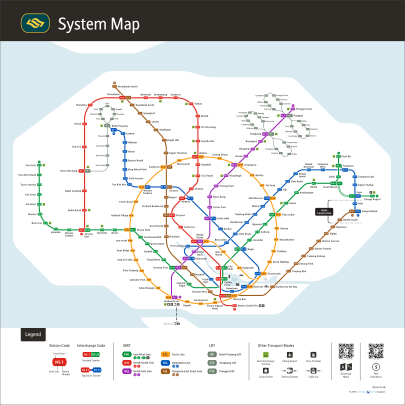
MRT maps label each line and its direction by its unique acronym and colour-code:
- East-West EWL (green line),
- North-South Line NSL (red line),
- North-East Line NEL (purple line),
- Circle Line CCL (yellow/orange line),
- Downtown Line DTL (blue line),
- Thomson-East Coast Line TEL (Brown line).
On MRT maps, stations have logical names and are numbered. You can tell where you are by the codes on the map e.g., NE5 in purple shows that you are on the purple north-east line at station 5.
Many stations have line interchanges if you need to change over to another line to head to another part of the city. You can see these interchanges on the map easily, which helps planning a journey. I recommend downloading the My Transport app on Apple or android. I found MRT stations to be very accessible. From street level, there are elevators and ramps down into the station. There are also elevators between the ticket level and platform levels.
Purchasing MRT tickets
At the ticket concourse, there is a wheelchair ticket gate that is plenty wide enough for a power wheelchair to fit through. There are several payment options:
- Contactless bank cards/credit cards/debit cards
- Mobile wallets (E.G. Apple Pay)
- EZ Link or NETS prepaid cards purchased via SimplyGo
It’s very simple to tap on/off with your credit card or mobile wallet. You just need to make sure that you have a separate card for each traveller to be able to tap on/off individually.
Boarding the MRT
At platform level, there are screen doors separate the platform from the train. This ensures you are safe while waiting for the train and don’t have to worry about your wheelchair rolling off the platform.
It is easy to identify which platform/train to hop on. The screen doors at each platform have colour-coded signage and the end of the line destination so that you know you are heading in the right direction.

Announcements and chimes also assist with knowing when your train is arriving. Trains arrive every 2-3 minutes during peak hours and 5-7 minutes off peak.
The train is at platform level with only a small gap. There was no ramp required to bridge this gap and I felt safe crossing the gap onto the train, unlike other trains I’ve been on where I feel like my wheels might fall into the gap.
There was some helpful signage with advice for how to board the train safely in a wheelchair (e.g., making sure your wheels are facing straight when driving onto the train).

MRT stations
As with anywhere in Singapore, the MRT stations are accessible and clean.
MRT stations usually have some convenience stores and food options, with some even having food halls for you to dine in.
Throughout, you’ll find elevators to help you move between levels. The colour-coded and numbered MRT map signage made it relatively easy to get to the correct MRT platform and train. The majority of stations we visited required very little effort to find our way. However, we found that some platforms were harder to find and getting out of the station to street level sometimes challenging.

At the Orchard station, we had no problems with the Thomson East Coast Brown line, but the entrance to the Red North South line was a bit more hidden. As Orchard MRT is underneath several Orchard Road shopping malls, you will want to look for the yellow numbered signs which point to exits for each building.
At Raffles Place, exiting the MRT resulted in us doing several loops of the CIMB building food court, before finding a hidden elevator between food court stalls. You will want to aim for exit M. I would recommend using Google maps, journey planning maps, or this station guide to navigate your way in and out of the MRT if you get lost.
Buses in Singapore
The buses in Singapore are also 100% wheelchair friendly.

The buses were helpful when MRT stations were a little far away from our destination or didn’t connect 2 destinations. For example, we caught buses from Little India to Kampong Glam, and then to Marina Bay.
The buses I used had wheelchair ramps that folded out from the rear door. The drivers appeared knowledgeable and were patient while I boarded and got off.
Inside the bus, I found it quite roomy compared to some other buses I’ve been on, allowing me to face my wheelchair towards the back of the bus and get on/off easily. We were travelling late afternoon but did not find the buses overly crowded.
Payment is the same as the MRT system with a tap on/off system. I also recommend using online apps and journey planners, similar to the MRT, to plan your journey and find the timetable.
Wheeling around Singapore
In central Singapore, it is possible to walk between districts as the distances aren’t huge. For example, we walked from Raffles Place MRT to the Marina Bay waterfront in about 20 minutes. However, it can get very hot in Singapore so if you don’t like the heat, public transport is a nicer option.
Check out my post on walking tours in Singapore, where I talk about some of the areas we walked. Overall, the pavements and curbs were very wheelchair friendly, with traffic lights for crossing major roads.
Overall impressions
Singapore has world-class public transport systems that make getting around in a wheelchair easy. In addition to the MRT and buses, you can use taxis, ride shares, or even walk parts of the city barrier free.
For more information, I recommend checking out the Accessible Singapore website which has additional information on transport options.
Ratings
Cobble scale: 5/5 Smooth (easy gliding on concrete services).
Barrier free barometer: 4/5 mostly accessible. Public transport is fantastic, but taxi services vary in quality.
Want more?
You can also check out my other posts on Singapore:
- How to find accessible accommodation in Singapore
- How to see Singapore Highlights in a wheelchair
- Gardens by the Bay in a wheelchair
- Hidden Singapore: unique accessible outdoor attractions
- Singapore neighbourhood guide
- Singapore Changi Airport accessibility guide
- Singapore hawker centre guide: best places to eat in Singapore
Accessible Singapore can also help you with booking transport and has useful information on their website relating to transport in Singapore.
Disclaimer
All opinions expressed in this blog are my own and all reviews are non-solicited. I understand that every disability is different, and what works for me may not work for everyone – it’s important to do your own research on any destination or accommodation to make sure that it meets your accessibility requirements.


Leave a Reply