
Been to Singapore before? Seen all the MUST-SEE attractions or wanting to get away from the tourist traps?
Here are 5 of my favourite lesser-known outdoor places to visit including gardens, reservoirs, and historic urban walks. These are also (mostly) free and wheelchair friendly.
#1. Singapore Botanic Gardens
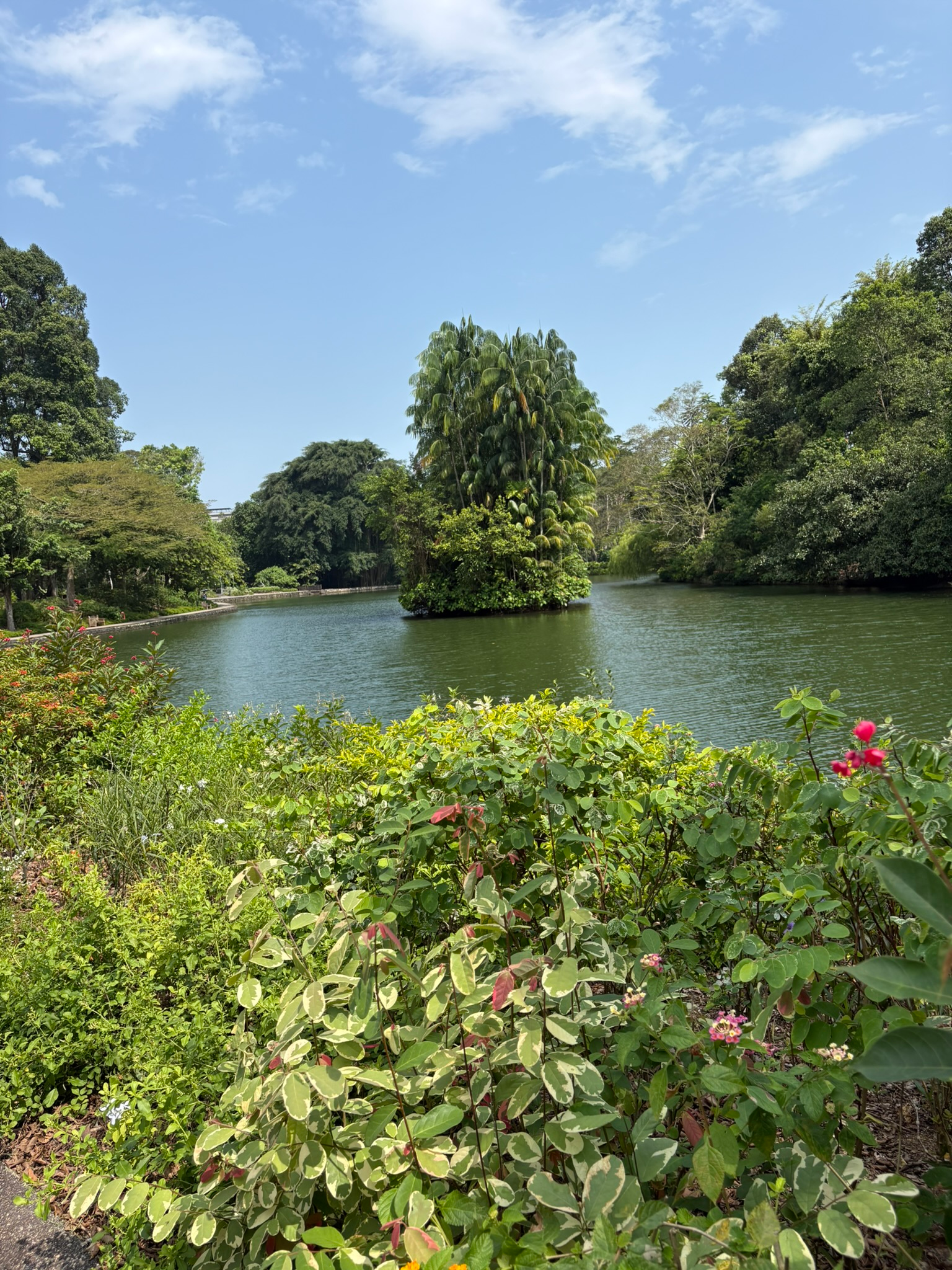
The Singapore botanic Gardens is a UNESCO world Heritage site. The gardens cover 82 hectares right in the middle of Singapore. You could easily spend the day exploring. We only had a few hours, but we still saw a lot and found it to be a nice escape from the heat.

Entrance to the gardens is free of charge, EXCEPT for the national Orchid Garden.
There is no signage for disability pricing for the Orchid Garden, so it probably depends on the staff on the day. The guy behind the counter did not charge me entry. However, the cranky lady at the entrance insisted I pay a $3 SDG entrance fee.
National Orchid Garden
The highlight of the gardens is the National Orchid Garden. This garden features over 3000 hybrid species of orchids – and the colours of these are spectacular!
In the Orchid Garden, we weaved our way through gardens full of purple, white, pink orchids, nestled amongst fern plants. The pathways took us under trellis archways, past rocky water features, and through misty cool greenhouses.


There a designated wheelchair route that provides a gentle and step-free path around the gardens. Keep your eye out for the wheelchair symbols painted on the concrete.

Other gardens
The remainder of the gardens also has a lot to offer. We explored gardens full of bamboo, foliage and fernery, fragrant flowers, herbs, palm trees, sprawling grass lawns, dense rainforests, and wetlands. Here, we spotted an otter springing out of the water into the bushes.


There were several other areas we didn’t get time to explore, including the arboretum, art gallery, and some historic museum areas. There is an accessible children’s playground with interactive activities, however only adults accompanying children are permitted.
Getting to and around the gardens
The Gardens are fully wheelchair accessible. All of the paths are wide, flat or mild slope incline, and made of concrete, pavement, or boardwalks. Most of the time, the surface was so comfortable I was able to enjoy the gardens without worrying about accessibility.

It is worth visiting a visitor information point to grab a map detailing accessible pathways, food outlets, and toilets. The website also has downloadable maps and accessibility info.

The gardens have a mix of food outlets: fine dining, cafés, food courts, and takeaway options. We grabbed a takeaway sandwich from the Little Farms café but it was expensive and not that nice. I’d recommend packing your own picnic and enjoying it in the gardens instead.
There are several entrances to the garden, many with accessible bus stations and parking.
We arrived via the eastern Bukit Timah gate, next to the Botanic Gardens MRT (servicing the yellow and blue lines). We exited via the Western Tanglin entrance, across the road from the Napier MRT (Brown East Coast Thomson line).

#2. MacRitchie Reservoir Park
This 12-hectare park is part of the Central Catchment Nature Reserve, Singapore’s original water supply, at the northern end of the city.
MacRitchie Reservoir is a large lake, surrounded by parklands and leafy forest trails, and is typically a little cooler than in the city. For that reason, it is a popular place for locals to take a break from the city and go for a jog or sit by the water on a hot day.

While there is a huge network of nature trails in the catchment area, very few are wheelchair accessible. The treetop Walk and MacRitchie Nature Trail are not wheelchair accessible.
The main reason we visited MacRitchie was because it is apparently the best spot in Singapore to see wild macaque monkeys, lizards, and birdlife.
Reservoir and Lornie Trail
The main reservoir pathway and Lornie Trail are wheelchair accessible.
Along the shoreline, we passed people using kayaks/canoes at the Paddle Lodge, fitness equipment, crossed the old reservoir wall and zigzag bridge, and headed into some hillier garden areas. No monkeys were seen, but it was a nice place to sit by the water.
The paths in this area were concrete and pavers, some of which were old and rougher. Other sections were hilly or had some steeper ramps.

Accessibility FAIL on the Prunus Trail
In our quest to find some monkeys, we also attempted the Prunus Trail. This was a boardwalk running along the edge of the reservoir between mangroves and rainforest.
The boardwalk was advertised on the website as accessible. In reality it was not.
The ramped boardwalk entrance was worn away and had a step. I was determined to see some monkeys, so we got creative and built our own ramp (MacGyver style) using some rocks and tree branches. It worked, but it was rough and I do not recommend doing this yourself.

The boardwalk itself was smooth. It was approximately 1 metre wide, had no edging, and did have a bit of a drop off on each side, so I kept to the centre of the path.
The boardwalk is around 2-3 km long. After getting halfway, not seeing any monkeys, and speaking to some hikers who told us there were steps at the far end, we cut our losses and returned to our makeshift ramp.
While the Trail had some nice greenery, birdlife, and some roosters, I would not recommend attempting the trail unless the entrance gets upgraded.

Getting to the reservoir
The best access is from Lornie Road near the amenity centre, with a bus station and multistorey parking.
We caught the MRT to Marymount (on the yellow circle line). From there, there are some brown signs that will guide you along the 1km path to the reservoir.
The website has some maps and further info about the reserve.
#3. East Coast Park
East Coast Park is a 15km stretch of parklands along the south-eastern coast of Singapore.
The park is a place to wander through some nice gardens, walk your dogs, stop at a café, and stroll or cycle along the shoreline – there are bike rental vendors everywhere.

The park is divided into sections A-H.
We visited areas E and F. These areas are home to the Extreme Skate Park and Cable Ski Park. That there is a big jetty and some “beach” swimming areas, with a bit of sand and no waves.


We spent some time counting container ships on the horizon. On the smoggy day we visited, we counted 60, but there were more hidden on the horizon.
Arriving at sunset, we had dinner at the East Coast Lagoon Food Centre. A popular place to watch the sunset over the lagoon. You can read my full review in my Singapore food guide.

Getting to and around East Coast Park
The park is fully accessible, with accessible toilets, parking, and bus stops at regular intervals. The website has maps and accessibility info, there are also maps throughout the park.
Using the MRT, there are several stations on the Brown East Coast Thomson line along the park. NOTE: the MRT stations are a solid 1-2km walk from the park, separated by a major road. However, there are concrete pathways and underpasses making it easy to get to the MRT stations.
For more information on using the MRT read my full transport guide here.
#4. Katong
Katong is one of Singapore’s oldest neighbourhoods. Originally, this area was all coconut plantations and resorts for the rich. Nowadays, Katong is mostly residential, but is a heritage area and hub for Peranakan culture.
The thing I loved about Katong was that it had a lot of charm and character, similar to Chinatown and Haji Lane. However, it is a quieter neighbourhood and was not swarming with Instagram influencers.

Katong Peranakan culture
We downloaded the Katong walking up from the visit Singapore website.
The must-see attraction in this area is the Peranakan shophouses. These are featured along many streets, but the best preserved are those on Koon Seng Road. We strolled along this street checking out the brightly coloured houses, with beautiful old shutters and painted tiles.


Katong features some really cool art murals, hidden down the side alleys.

I also enjoyed just strolling down Joo Chiat Road, a busy shopping street, with some interesting interior decorating, food, and (unusually large number of) dog grooming shops.

We visited the Sri Senpaga Vinayagar temple, hidden among residential buildings on Ceylon Road. This temple has a colourful 21-metre (68 feet) golden entrance tower and some beautiful carvings inside the temple.

Unfortunately, when we visited, the temple was under construction. However, we were still able to use the flat side entry to go inside.

The East Coast Road area is famous for Katong Laksa and has one of the oldest coffee shops in Singapore, Chin Mee Chin confectionary, that serves traditional Kaya toast and Kopi (coffee).
We opted for lunch in SG Hawker, a Hawker market style food court hidden in the basement of a shopping centre. It was probably less authentic, but it was accessible, had air-conditioning, and my roast chicken and rice was delicious.
Check out my full Singapore hawker centre and Food guide here
Getting to and around Katong
Being an old, heritage neighbourhood, there are some limitations on accessibility. However, it is still very doable in a wheelchair.
Many of the heritage buildings and museums were not accessible. A lot of the shops had one step.

Although I expected some older, bumpier concrete footpaths, I did not expect driveways with steep dips at regular intervals. Nor did I expect the covered shopfront alcoves to be split-level, with a step at random intervals.
There were some sections where you could skirt around the alcoves on some flat, but narrow paved areas. However, often these were blocked by rubbish bins. In several sections, we had to backtrack or use accessible curb crossings, crossing the street for accessible routes.

Closer to East Coast Road, the pavements became more modern and accessible. The residential back streets were more accessible. There were no cars, so I just drove along the street.


Katong sits halfway between the airport and Singapore city. It is only a 15-minute bus or taxi ride from each.
There are several MRT stops on the Brown East Coast Thomson MRT line in Katong, and you can be in the city in under 15 minutes. The route to the airport is longer via MRT (around 90 minutes with some interchanges), however there is a new section of track under construction that will link Katong to the airport more directly.
For more information check out my Singapore transport guide.
#5. Singapore River
The Singapore River stretches for around 3km inland from Marina Bay.
Our evening stroll along the river was lovely – the perfect temperature and relaxed atmosphere. It was great place for people watching as we passed bustling restaurants and saw many bumboat tours cruising along the river.
As evening turned to night, we admired the colourful historic buildings being illuminated against the Singaporean skyline lights.

There are 3 main areas to explore, getting quieter and more authentic the further inland you head:
Boat Quay
Located near the financial district and nearest to Marina Bay, this part of the river was probably my least favourite – it was busier and most touristy.
My parents spent the evening here watching a football match at a sports bar. For them, it was a great atmosphere to watch the live game.
Strolling along the riverfront, there were a ton of restaurants, a lot with crayfish crammed in tiny tanks out the front, and we were stopped regularly by waiters trying to get us in the door.

I would say this is a good place to go if you are with a large group, looking for a quick dinner, or prefer chain restaurants.
Clark Quay
I enjoyed Clark Quay much more! This area was quieter and felt more authentic.
In this area, one side of the river is newer and has some shopping centres/chain restaurants. However, on the older side of the river there are pretty, pastel-coloured historic buildings with some restaurants by the water.
While my parents were downriver watching their football game, Liv and I enjoyed some of our favourite pastimes – wandering through the historic area with some ice cream, followed by a delicious fresh seafood dinner overlooking the river.


At night, this area gave off fairground/coastal boardwalk vibes. We passed people screaming as they were flung into the air on the Giant Slingshot, and the waterfront was illuminated by the beautiful old Quay buildings being lit up.

The Old Hill Police Station is pretty by day and night, with 927 shutters and awnings in all colours of the rainbow.
Robertson Quay
We didn’t visit this area, but I’m told it is a quieter, more upmarket and residential area, with some nice restaurants, that is popular with the locals.
Getting to and around Singapore River
The Riverside pathways are a mix of concrete, pavers, and boardwalks. These are mostly smooth and flat incline. There are some underpass tunnels under roads, and accessible bridges to get across the river.

Many of the older buildings were not accessible, with either a step or staircase inside. The newer shopping centre buildings were accessible, with elevators and ramp access. Alfresco dining was also accessible, with ramp access onto the waterfront dining platforms.
Unfortunately, the river cruises/bumboats were not wheelchair accessible. The gangways had a step at either end. The entrance onto the boat was too narrow for an electric wheelchair.
This area is centrally located, easily accessible by walking/rolling, bus, taxi, or MRT, with stations within 15-minutes’ walk at Raffles City, Clark Quay, Fort Canning, Havelock, and Great World.
Verdict
Singapore Botanic Gardens and East Coast Park were the most accessible. Katong and MacRitchie Reservoir were accessible, but with some limitations. The best thing of these destinations is you can spend an entire day with your only expenses being transport and food.
These are great places to get away from the touristy attractions and see more of the local side of Singapore.
Want more?
Check out my other Singapore accessibility guides:
Singapore highlights in a wheelchair
Gardens by the Bay wheelchair guide
Singapore neighbourhood guide
Singapore hotel guide and reviews
Singapore accessible transport guide
Singapore Changi accessibility guide
Singapore hawker centre and Food guide
The accessible Singapore website also has tons of useful information about visiting these places and more.
You can also book accessible tours with Ludus Lab.
Disclaimer
All opinions expressed in this blog are my own and all reviews are non-solicited.
I understand that every disability is different, and what works for me may not work for everyone – it’s important to do your own research on any destination or accommodation to make sure that it meets your accessibility requirements.
Leave a Reply