
When it comes to choosing where to stay in Singapore, there are a lot of neighbourhoods to choose from.
This guide will give you an overview of each neighbourhood and accommodation options. I review accessibility, public transport options, and things to see in each area.
For detailed hotel reviews, check out my post on Singapore accessible hotel options.
Published November 2025, and updated October 2026 following a more recent trip to Singapore.
Which area of Singapore to stay in?
Despite being a small island, Singapore has a huge range of options for areas to stay. Neighbourhoods/areas range from big city vibes to beach resorts, to authentic local neighbourhoods.
But, how do you know which area to stay in? How accessible is it for visitors with disabilities? Is there public transport nearby? What is there to see and do?
We have stayed in several areas: Changi Airport, Orchard Road/city, and the quieter East Coast road area. Each has their pros and cons, and there were several reasons why we chose these different areas each time we stayed.
Read on to find out whether each neighbourhood suits your travel style.
Orchard Road
Vibe: Green city shopping area
This is the central shopping district. If you like shopping, this is the place for you, there are tons of skyscraper and underground shopping centres along Orchard Road.
In my experience, the more expensive designer stores were at street level of the shopping centres. Of course, the more affordable stores (e.g., H&M) can be found hidden underground in the shopping centres.
Despite being in the middle of the city, the Orchard Road area feels quite open and green. The streets are wide, tree-lined, and you’ll find gardens growing from the sides of buildings. There are a few little park areas around as well.

Orchard Road accessibility and hotels
This area is very close to the MRT, giving you easy access to other areas of Singapore. There are several MRT entrances, either with street level access, or accessed via the multiple shopping centres.
Some of the shopping centre exits were a little bit tricky in the wheelchair due to steps and hidden elevators. It did take us a while to find street level exits. Make sure you check out the exit maps when leaving the MRT, or have a navigation app handy.
As this MRT is on both the red and brown lines, it is well-connected to all the main Singapore attractions, and to other line interchange stations to get to other areas. Check out my Singapore MRT and public transport guide here.
Wheelchair access in the Orchard Road area is very good. You’ll find flat, wide, modern pavements. There are designated pedestrian crossings for major roads. Some sidestreets you have slightly rougher older concrete paths and curb cutouts.
Many buildings did have split-level entrances, with steps up/down into some shopping centres or fast food outlets. Convenience stores also often had a step. However, we often found hidden entrances that were accessible into the back of convenience stores or into shopping centres.
Hotels in this area are mostly mid-range to luxury in terms of budget. During our stay, we stayed at the Voco Orchard, which was a mid-range modern hotel. Check out the full review of this hotel here.

Sentosa Island
Vibe: Family friendly beach resorts
This island is for the resort lovers. Here, you will find Universal Studios and other family friendly activities. There are several beaches, with water sport activities on the island.

Sentosa accessibility and hotels
I have not yet visited Sentosa (saving that for a future trip), however I have done quite a bit of research as we were considering Sentosa as an option on our first trip.
Hotels on this island are mostly on the pricier side (e.g., Sofitel) although there are some cheaper family friendly options available as well.
As most 4 and 5 star hotels have good accessible options, my research suggests you’ll find some good (although more expensive) accessible hotels here.
One of the reasons why we have not yet stayed at Sentosa is because it is further out from the city and the airport. For us, it wasn’t a practical option for a 24-48 hour stopover. It would be better suited to a more relaxed, longer stay in Singapore.
Sentosa is connected to the main areas of Singapore via the Harbourfront MRT station. From Harbourfront MRT, there is the Sentosa express monorail and public shuttle bus that are both accessible for wheelchairs.
Sentosa Island itself has a mix of terrain, but there have been huge efforts to make it more accessible. This includes some treetop sky walks including the new SensoryScape, and beach pathways. Within Resortworld, you’ll find accessible infrastructure throughout.
A great way to explore Sentosa is with Ludus Lab’s fully accessible Sentosa Island tour.
Marina Bay
Vibe: Luxurious city skyline and water views
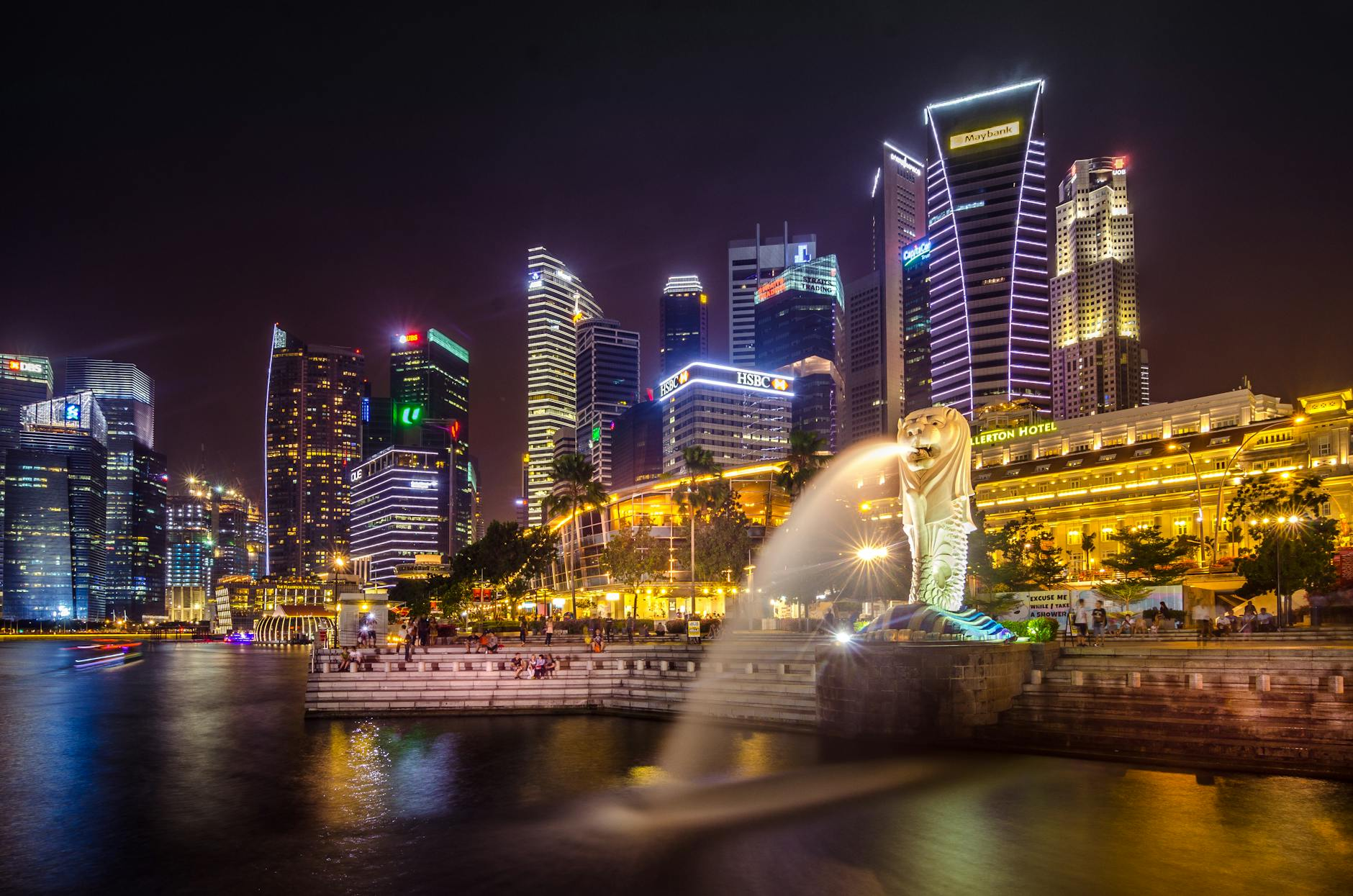
If you want picture postcard Marina Bay waterfront views from your hotel, this is the place for you. Here, you can either stay in the famous Marina Bay Sands Hotel or stay at a nearby hotel with views of the Marina Bay Sands.
On one side of the bay, you have the famous Marina Bay Sands hotel, which has shopping and restaurants in its precinct. This area is very close to Gardens by the Bay. Check out my guide to Gardens by the Bay here.
On the other side of the bay (Jubilee Bridge/Esplanade side) you are closer to the Singapore River and look across to the Marina Bay Sands and across the city skyline. Here, you are nearby the Esplanade shopping centre and theatre district.
This area is a great place to stay if you want to be within walking distance of the main attractions and waterfront restaurants.
For more about the Marina Bay area, check out my guide on Singapore highlights.

Marina Bay accessibility and hotels
The amazing views do come with a price tag, with hotels in this area being some of the most expensive. A night at the Marina Bay Sands will set you back approximately $1500 SDG.
An advantage of this area is its connectivity to main sites in Singapore. You only need to look out your window to see many of the main “must see” attractions.
Staying on the Marina Bay Sands side, while the pavements are moderate and flat concrete, it is quite a trek wheeling/walking around the Bay to the city. There are a couple of nearby MRT stations that will connect you with the rest of the city.
The Esplanade side places you very close to the city. The nearest MRT is Raffles City about 5 minutes walk away. For wheelchair users, the MRT entrance is not easy to find (enter via CIMB building, exit M). However, once you figure that out, the MRT is very well-connected via red and green lines to most of the city.
Check out my Singapore transport guide for more information.


We also found it difficult to get the wheelchair down near the waterfront (Jubilee Bridge is the easiest entrance). However, along the waterfront itself is very wheelchair friendly with ramps and flat ground.
Singapore River
Vibe: Riverfront views with restaurants and nightlife
This area includes Clark Quay, Robertson Quay, and Boat Quay which sit along the Singapore River.
This area is the place to stay if you are looking for nightlife.

Boat Quay, being the closest to Marina Bay felt the most touristy. Expect bustling Riverside pubs and restaurants, with crayfish in tanks at the front, and waiters trying to get you stop at their restaurant. I personally found this area crowded and too touristy.
Clark Quay has kept its historical charm with coloured shop houses. It was quieter, but does have some touristy restaurants along the waterfront. With a giant slingshot, and pretty lights at night, it was a little touristy but had a nice feel to it.

We didn’t visit Robertson Quay, but I have been told it is quieter and less touristy.
This area is close to Fort Canning and Marina Bay, and has a lot of food/shopping options. It’s a handy central location.
For detailed information about this area, check out my Hidden Singapore: unique outdoor attractions guide.
Singapore River accessibility and hotels
Here, you can get some nice views from your hotel of the river. Accommodation ranges from budget through to luxury in this area.
There are a few MRT stations in this area, at Clark Quay, Raffles City, Fort Canning, and City Hall. However, depending where you are staying on the river, stations can be 15-20 minute stroll away. Check out my Singapore transport guide for more info.
Along the river, the foot paths are mixed quality. Some newer sections are smooth concrete. Other older sections are paved and rougher. There are ramps, bridges, and underpasses that help you get over the river, under streets, and into buildings.

I was pleasantly surprised that most restaurants with outdoor dining had ramp access onto the raised dining platforms. Most shops and restaurants at flat access at ground level, although there were some second-storey places in the older buildings you would not be able to access. On a more modern side with the shopping centres, there are elevators to get you upstairs.
A popular attraction along the Singapore River is the Singapore River cruises, particularly at night with the pretty lights. However, unfortunately none of these cruises are wheelchair accessible, unless you are able to transfer out of your wheelchair (there are a couple of steps onto the gangway ramp and then into the boats).
Chinatown and Little India
Vibe: Authentic Singapore food and culture
These are separate areas of Singapore but similar in terms of vibe, accessibility, and accommodation options.

This is the place to stay if you want to be in the middle of local food and culture. As soon as you leave your hotel, your senses are smacked with old coloured buildings, street food, and markets.
Both areas have amazing Hawker Centres for authentic Singaporean food. Check out my Singapore hawker centre guide for more info.
We did a walking tour in Little India and Chinatown, this was a great place to explore local culture. For more info, check out my Singapore highlights guide.
Chinatown and Little India accessibility and hotels
Here, you will often find some more boutique, budget, and midrange hotel options. In my research, hotel rooms tended to be a bit smaller in size (more your Ibis or Hilton budget style hotels).
Both Chinatown and Little India are close to MRT stations, so convenient for accessing other areas.
However, the accessibility of streets is a bit of a downside of staying in these areas. While most pavements are generally flat, they are a bit older there are some bumpy sections, and curb cutouts that are a bit steep or rough.


East Coast Park/Katong
Vibe: Older authentic neighbourhood and family friendly bayfront parklands
We stayed in Katong in our most recent Singapore stay. I was looking for somewhere that was still well-connected to transport and attractions, but quieter and more authentic Singapore.
Check out my Hidden Singapore: Unique accessible outdoor attractions guide for more information about these areas.
Katong is an older neighbourhood of Singapore, with colourful shop houses, street murals, and traditional Singapore food options.

East Coast Park is a 15 km stretch of parklands along the southern coast of Singapore. This family friendly area has playgrounds, cycling paths, food options, and more.

Katong/East Coast Park accessibility and hotels
In this area, you’ll find mostly mid-range hotels that are a bit nicer on the budget. We stayed at the Grand Mercure Hotel Roxy in Katong, which was approximately 250 SDG per night. For a full review of the hotel click here.
This area is well connected to the airport (15 minute taxi) and to the city via bus or MRT. The brown East Coast Thomson line has several stations connecting East Coast Park areas with the city. You can get into the city in around 20 minutes. Check out my Singapore accessible transport guide here.
East Coast Park itself is flat, with modern concrete pathways all along it, making it a smooth ride for wheelchairs.

If you are visiting East Coast Park, expect to do some miles in your wheelchair. The park itself is 15 km long, and MRT stations are at least 1 km away from the park and there are several kilometres between each MRT station. So, you do need to be mindful of which part of the park you want to visit and where nearest MRT stations are.
There are some busy roads that separate MRT stations and hotels from East Coast Park. However, there are concrete pathways, some larger traffic lights with pedestrian crossings, and underpasses that will get you across these roads safely.


Katong is older and I was surprised by how inaccessible some of the streets/pavements were. Some of the newer streets (e.g., East Coast Road), were smoother and had nice curb cut outs.
However, some of the older streets (e.g., Joo Chiat Road) were a real struggle! Many foot paths when under shop fronts, and these at random steps that one end all the other. The foot paths also tended to be like riding a rollercoaster, with lots of ups and downs. Many shopfronts also had a step at the entrance.


The newer shopping centres in Katong were much better, with elevators and ramp access.
Airport
Okay, in most cities the airport is not really a neighbourhood or area worth exploring. In Singapore though, you could actually spend a couple of days at Changi Airport.
The airport is itself a tourist attraction, so you can spend several hours checking out the “Jewel” indoor waterfall, airport butterfly garden, movie theatre, day spa, shopping, and other attractions.


This is the perfect place to stay if you are having a short stopover of less than 48 hours in Singapore. You are close to the airport, have things to do, while still being easily connected to Singapore’s attractions.
Changi airport accessibility and hotels
There are a couple of hotel choices at Changi Airport. The main option is the Crowne Plaza hotel, located inside Terminal 3. Check out my full review of the Crowne Plaza here. There are some smaller short-stay and cubicle options, although these are tiny and not particularly wheelchair friendly.

Being a modern airport, wheelchair accessibility within terminals is excellent. You can expect smooth floorings and elevators inside The Jewel and terminals.
Check out my full Changi Airport guide here for more information.
To get between the terminals and the Jewel, you can catch the accessible air train – this is worth it just for a ride through the indoor waterfall. There is also an indoor walkway between T3 and the Jewel – this is approximately 1 km long, but there are some travellers you can ride along.
To get to the city, there is an MRT station located under terminal 3. This MRT goes to Tanah Merah MRT interchange, where you can then transfer to other trains to take you into the city. This generally takes around 30 minutes to get from the airport into city stations.
The verdict?
There is a lot of choice areas to stay. The main things you will want to consider are:
- what sorts of things you want to see?
- How accessible the neighbourhood is
- price range of hotels
- distance to MRT station, airport, and attractions
- the neighbourhood vibe
In my experience, all of the neighbourhoods are safe. While some areas are more accessible than others, they all offer unique experiences and are worth visiting.
Want more?
For more information on accessible accommodation in Singapore, check out the accessible Singapore website.
You can also check out my other posts on accessible Singapore:
How to find the best hotels in Singapore (hotel reviews)
How to See Singapore in a Wheelchair
Getting around Singapore in a Wheelchair
Gardens by the Bay In a Wheelchair
Changi Airport Singapore wheelchair guide
Hidden Singapore: Unique accessible outdoor attractions
Singapore Hawker centres: where to eat in Singapore
Disclaimer
All opinions expressed in this blog are my own and all reviews are non-solicited. I understand that every disability is different, and what works for me may not work for everyone – it’s important to do your own research on any destination or accommodation to make sure that it meets your accessibility requirements.
Leave a Reply