
There are a lot of ways to get around London – London black taxis, double-decker buses, hop on hop buses, the underground, overground rail, river ferry, or simply walking/rolling.
But what is the best way to get around and see the sights of London? And which are wheelchair accessible?
Prior to our London trip in June 2025, I spent a lot of time researching all the options for sightseeing, airport transfers, and getting out to Hertfordshire to visit a colleague.
To be honest, it was overwhelming! It was hard to tell what would work, and we arrived in London not 100% sure we would get where we wanted.
However, with the help of some useful apps and advice from the team at Wonders of London, I used taxis, busses, the underground, overground rail, and walking tours. We were surprised by how easy it was to get around London in a wheelchair.
In this post, you’ll find an overview of the various options for getting around London to help you plan your own travel in London. This post will cover the basics of navigating London, including accessibility features and costs.
There are some great apps make navigating London in a wheelchair much easier!
We used the following apps:
- Transport for London (TfL) – this is London’s official transport app. It has up-to-date information about accessible bus and train routes, lift access, and accessible toilets. I found this really easy to use, particularly for navigating the subway system.
- CityMapper – This is a general navigation/map app that provides accessible routes. This was most useful when on walking routes.
- Sociability – this app provides information about accessible bars, restaurants, and cafés. This app has detailed information about ramps, toilets, and access features.
- Euan’s guide – this app provides reviews of accessibility in London and across the UK.
Transport options
London black taxis
London’s black taxis are iconic, and I definitely wanted to have a ride in one. We took a 15-minute ride between the Natural History Museum in Kensington to our accommodation in Hammersmith.
You can pre-book via apps, hail a taxi, or find one at a taxi rank (that’s what we did).
Legally, London’s black taxis are required to be wheelchair accessible. That means you can jump in any cab and it will be accessible. Outside of the main parts of London, there are some wheelchair taxis owned by private companies you can use as well.
All black cabs are fitted with a foldout ramp, attachments to secure the wheelchair, and drivers trained to assist wheelchair users. Many have a swivel chair and grab handles to help passengers enter the car if they are transferring out of a wheelchair.

The dimensions of most black taxis are as follows:
- 27.5 inches/700mm wide,
- 47 inches/1200mm long,
- 53 inches/1350mm high,
- 47 inches/1200mm doorway height
My wheelchair only just fit within these dimensions. I had to recline my chair to get through the doorway and it was a tight squeeze with me and my 3 companions in the back.
The ride in the taxi was quite comfortable. The new electric cars are a little bit bigger, quieter, and smooth. Visibility out the side windows wasn’t great due to the height of my wheelchair, but there was a ceiling window allowed me to see trees and tops of buildings.
FUN FACT: to become a London black cab driver, requires completion of a course known as “the knowledge”. This takes 3-4 years complete and includes memorising over 300 core city routes. Drivers are also trained to provide recommendations for restaurants, theatres, and other points of interest.
Academic research has also found that after their training, these London taxi drivers have a larger hippocampus (the part of the brain responsible for spatial navigation)!
Double-decker buses
Being another London icon, I wanted to take a ride on a double-decker bus. This was the best option for us to get from our accommodation in Hammersmith to Kensington Palace (a 25-minute ride).

All public buses in London are wheelchair accessible. All buses are equipped with ramps. Buses are also able to kneel, and lower to make access to the curb easier.
There is a dedicated wheelchair space about halfway along the bus. These fit a reference wheelchair of around 27.5 inches/700mm wide by 47 inches/1200mm long.
NOTE: wheelchairs are to be given priority over strollers/buggies in this section of the bus.
I found the buses easy to get on and off, the driver was patient and checked with us when we boarded where we wanted to go to. I found the wheelchair space to be okay in size, even in my large wheelchair. The thing I liked about the bus was the good visibility out the windows.
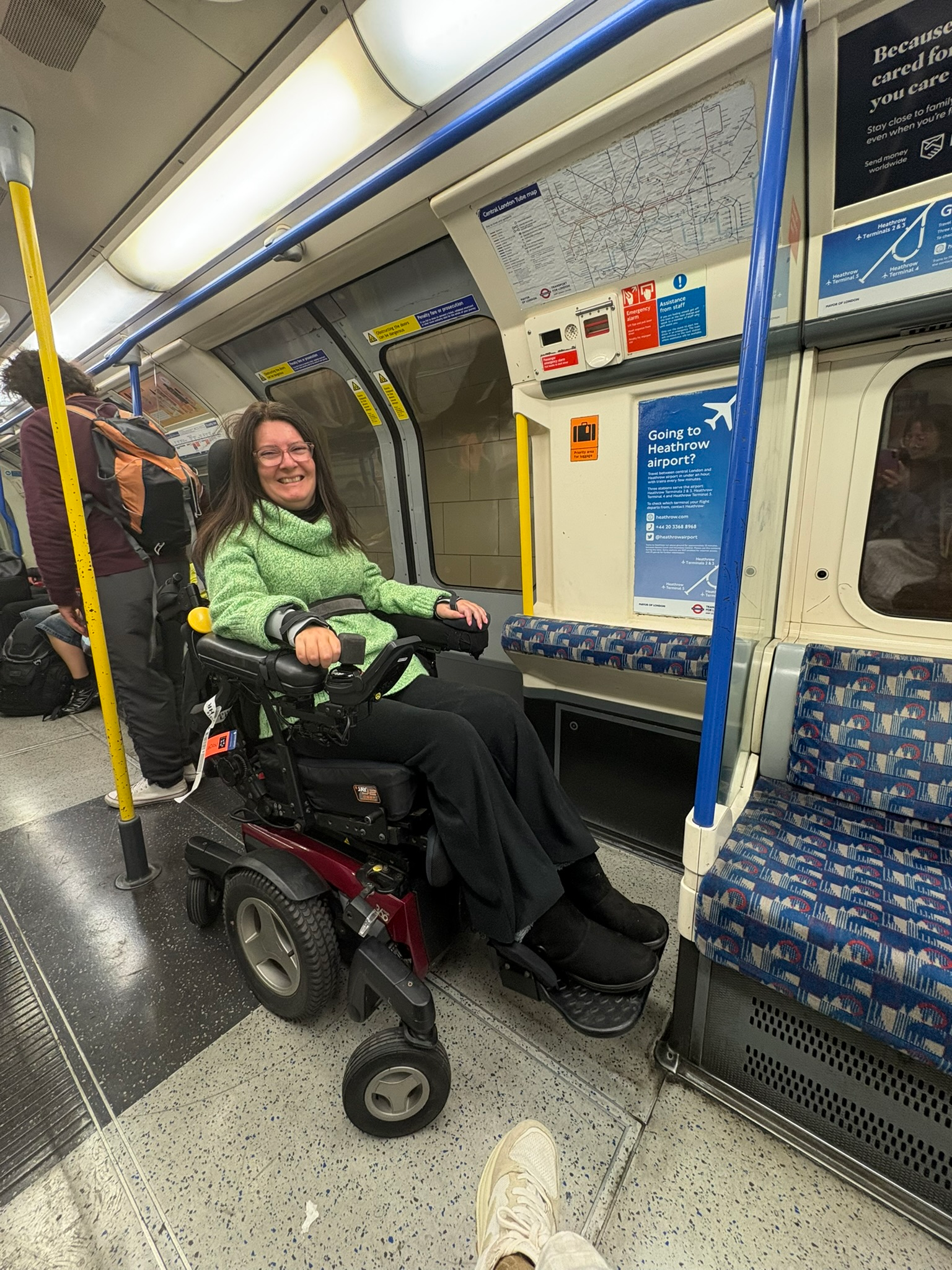
The London Underground (the Tube)
This was the mode of transport we were most anxious about. Only around a third of stations are step free, the maps complex, and tube stations are notoriously crowded in peak times.
In the end, the underground was our most used form of transport in London. We used it to get from the airport to our accommodation in Hammersmith, on our Wonders of London tour, and get to and from central London from Hammersmith.
The best advice I can give is to check out the TfL website for accessibility information and use the TfL app to plan your step free journey and help you navigate in the day. They have great information about elevators, step free platforms/stations, and other accessibility info.
There are some stations that are step free, but the gap between the train and platform means that you need a boarding ramp. The platform at many stations is at the same level as the train. However other stations have a boarding hump, which is a raised area of the platform with a wheelchair sign to help you board. There are lots of maps on the train to help you out as well.

On the train maps, look out for the following symbols:
- Blue Wheelchair Symbol – this means step free access from the street to the train. The gap onto the train is minimal and you shouldn’t need a ramp.
- White wheelchair symbol – this means that there is step free access from the street to the station platform. However, you will need a boarding ramp due to a large gap between the platform and train.
When arriving at each station, we asked station staff (easily identifiable with bright orange vests) for assistance. They either escorted us to the train or radioed through to ensure a ramp was available if needed.
We used credit cards on the day to pay for our trip.
After 1 or 2 trips, we found the underground quite easy to navigate. We avoided peak times so found the trains quiet. There is a designated wheelchair space, which had plenty of room. The trains had good visibility out the window and were a relaxing way to get between places.

Overground rail
We took the overground rail from King’s Cross station to Herefordshire to visit a colleague.
We pre-booked our seats on the Northern Rail online. They had an App which was very helpful for storing our tickets. The website has some great information to help you plan your journey.
I highly recommend pre-booking Passenger Assist online, via text, or on the app. This gives station staff noticed that you’ll be arriving so that they can best support you.
At King’s Cross station, we found the passenger assist booth and were escorted by staff to the train platform. As the overground rail trains are quite high, a long ramp is used to help you board. Stationmaster radioed through so that a ramp was ready for us to disembark at the other end.

We had a pre-booked accessible seat and companion seat, which was quite roomy. There was good visibility out the windows, and nice to see some of the countryside and suburbs of London.
King’s Cross station
King’s Cross is one of London’s larger stations. The main hub for northern lines and is well connected to the underground system. We found it easy to connect from our tube platform to our Northern Rail platform.
Our stop at King’s Cross station was not just part of our journey, it was a destination on our itinerary. Why?
We needed to visit platform 9 ¾. For any muggles reading this, platform 9 ¾ is the brick wall where wizards, such as the famous Harry Potter, pass through to catch the Hogwarts Express.

One of the first things my carer and I bonded over when we met was our love of Harry Potter. We were very excited to have our photos taken at platform 9 ¾ while visiting the station.
Thames River cruises
A cruise along the Thames is a great way to see many of London’s iconic sites. We took an Uber boat by Thames Clippers from the pier at the Tower of London to Westminster Pier (25-minute ride).
You can pre-book online, but we just bought our tickets at the pier on the day.

These boats are wheelchair accessible, although there are a couple of piers that you cannot assess due to issues with the tides. The pier itself was reasonably flat and easy to navigate with the wheelchair. The Thames was quite rough when I was boarding, so the gangplank was moving quite a lot up and down as I was crossing it.
Wheelchairs can only access the bottom level of the boat, which is mostly inside areas. There is no designated seating, so I just pulled up in a wider area at the end of an aisle.
The cruise was relaxing way to look at the windows and see London Eye, Houses of Parliament, and the various bridges along the way.
Tour options
This was something we struggled with when planning our trip. What was the best way to see as much of London as possible in 2 days, while being not too expensive?
London black taxi tour
This was the most expensive option. Given their extensive training, London black taxi drivers are equipped to offer accessible tours in their wheelchair friendly taxis.
We were quite interested in this option as we would get to see a lot of sites by jumping in and out of the car, have the driver as our guide, and it was a safe option for wet weather. The downside was the cost and risk of wasting time stuck in traffic. We were also concerned about whether my large wheelchair would fit in the black taxi.
Hop on hop off bus tour
We were very close to choosing this option. We were looking at the Big Bus tour, which had routes that covered all the places we wanted to see.

Having had done a hop off bus tour in another city previously, we liked the flexibility of being able to stop at places we wanted to see and skip those we didn’t. It was also a good option if the weather was bad.
The buses have a designated wheelchair space on the lower level, ramp access, and good visibility out the windows. The audio guide also points out interesting landmarks.
Our main concerns about the hop on hop off bus was being stuck in traffic, and buses being crowded (which sometimes means needing to wait for the next bus).
A friend of mine did the hop on hop off bus tour a week before we visited and loved it, so it probably was quite a good option to see the city.
We also considered doing this accessible afternoon tea bus tour. They had gluten-free and other options to accommodate dietary requirements.
Walking/rolling + public transport
This was the cheapest option. However, we decided not to go with this because of our uncertainty about the accessibility of the underground and the distances between places.
After visiting London, we found the distances between places not too bad at all (everything seems closer in real life than on the map).
Another factor was that by just wandering around, we wouldn’t learn anything about the places we were seeing, might miss some interesting hidden gems, and would end up arguing when we inevitably got lost.
Walking tours
This is the option we ended up choosing. We love walking tours.
There are lots of free walking tours available in London – we looked at these, but they weren’t running at times that worked for us (most started too early in the morning) or weren’t going to the places we wanted to see. Some weren’t accessible or lacked accessibility info on websites.
We opted for a private, 6-hour customised accessible walking tour with Wonders of London.
This tour had a lot of advantages for us.
We were able to choose our own itinerary. We didn’t get stuck in traffic. There was an opportunity to chat with our guide and learn more about the city.
The guide also gave us great advice and support in navigating the public transport systems, so that we were confident to do it on our own the following day.

The only downside was the weather. We only booked a few days prior to our tour, so thankfully were able to pick a day with sunshine. Had the tour been the following day, we would have been wet and cold (see my related post on rainy day London activities).
Costs
Below is a rough guide of how the various options compared:
- one-day public transport (£8-£16 each)
- 15-minute taxi transfer (£60)
- full-day private taxi black tour with guide for 4 people (£300-£800)
- one day hop on hop off bus ticket (£30-£40 each)
- 6-hour private walking tour with guide for 4 people (£280)
If you feel comfortable, public transport is definitely the cheapest option. Hop on hop off buses are a good cheap alternative. Taxis on the other hand are VERY expensive.
Compared to many other cities in the world we have visited, we found guided tours in London (and everything in London really) was much more expensive.
Overall impressions
We found the various forms of getting around London to be quite accessible. With the help of apps and a little bit of research to plan our journeys, we didn’t get lost or stuck anywhere.
We did stick to pretty central areas of London. Accessibility in some outer suburbs might be more challenging.
I definitely recommend making the most of the TfL website and app make your trip easier.
Want more?
For more information about accessible travel in London, check out my related posts: