
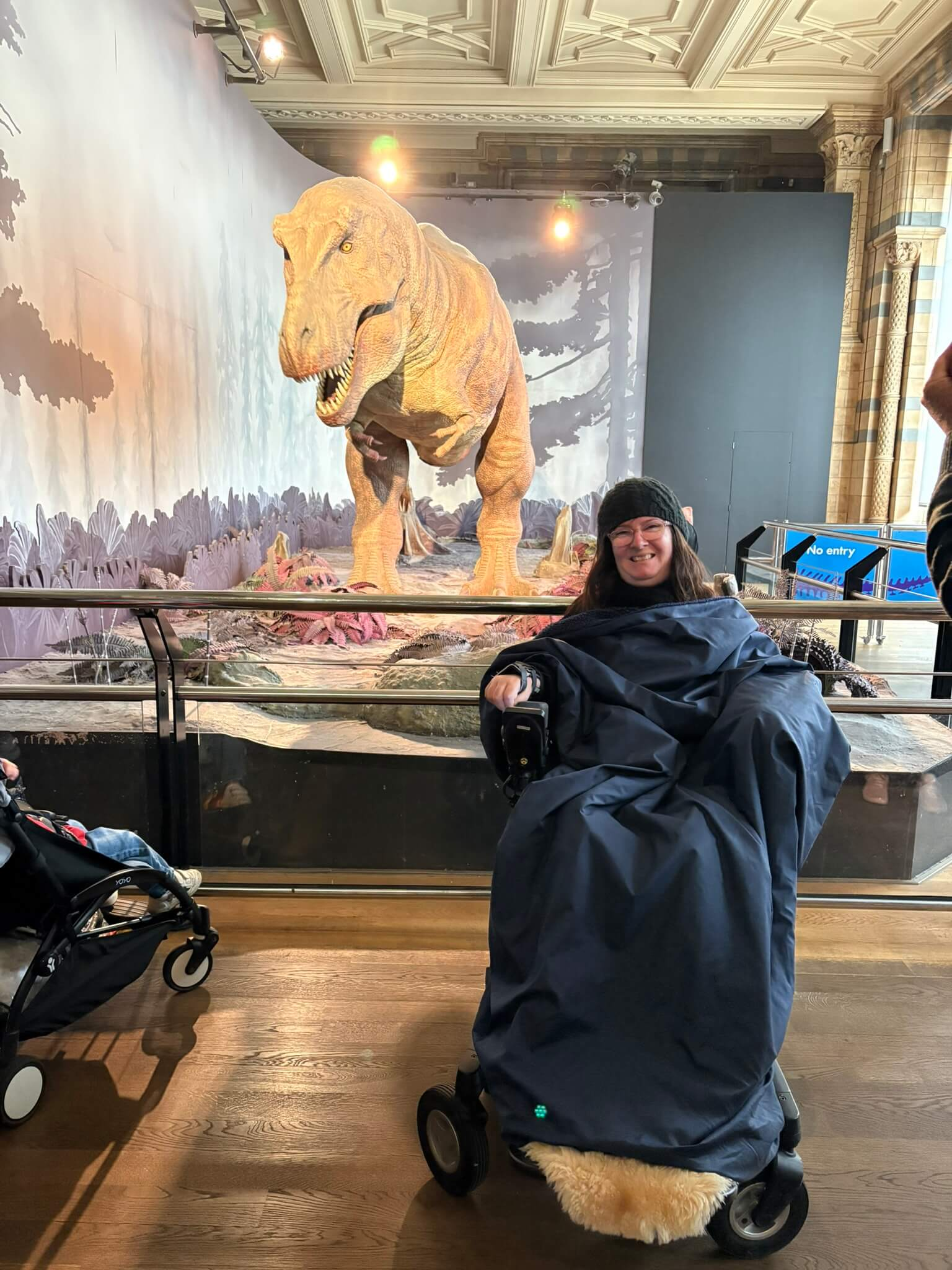
Getting caught in the rain isn’t fun for anyone, but it can be especially challenging for travellers with disability, families with young kids, or anyone staying somewhere with limited laundry or drying facilities.
For me, keeping my wheelchair electrical controls dry is essential. Because I have temperature regulation issues, getting wet and cold causes my muscles to cease up and makes it extremely difficult to drive my wheelchair.
London has a reputation for being rainy – with around 120 wet days per year. Therefore, having a wet weather backup plan in London is absolutely essential. Luckily, London has plenty of wheelchair accessible indoor attractions that you can escape to on a rainy day.
During our June 2025 visit to London, we had a full day of rain showers and put our indoor itinerary to the test.
In this post, find out about our visit to Kensington Palace and the Natural History Museum, as well as some tips for accessibility, particularly in the rain.
Kensington Palace
We booked a Kensington Palace tour prior to knowing the weather forecast. But when we saw it was going to be wet on the day of our visit, we were glad we had an indoor activity ready.
Having been a long-time fan of the Royals, I was keen to visit Kensington Palace.

We spent about 2.5 hours exploring Kensington Palace. If you want to explore the gardens (on a sunny day) you will need a bit more time.
The palace is separated into several exhibits.
- Victoria: A Royal Childhood Exhibition takes you through the childhood of Queen Victoria. Here, we saw some of Victoria’s beautiful gowns, her childhood bedroom, and got an insight into her playful side and childhood dogs.
- The King’s State Apartments tour takes you through the presence chamber, privy chamber, and cupola room. These rooms are ornately decorated with tapestries and painted ceilings. The cupola room features an impressive musical clock.
- The Queen’s State Apartments focus on Queen Mary II (and William III). These apartments take you through the Queen’s dining rooms, drawing rooms, gallery of artefacts, and bedroom.


The palace also has exhibitions that change regularly. When we visited, there was a fashion exhibition on, highlighting some Royal outfits and young designers.
Accessibility at Kensington Palace
The palace has some good accessibility features. The Kensington Palace website has great information about accessibility.
People with disabilities can purchase a discounted concession ticket. Companions get free entry. It’s worth booking online ahead to secure a timeslot.
There is flat access into the palace and accessible toilets, although we found the accessible cubicle to be barely big enough to fit my wheelchair. The doors also felt very heavy.
There is an elevator, average in size, that takes you to the top of the King’s staircase.
All of the exhibitions have hard timber floors, that are nice and smooth, but a bit squeaky with the wheelchair wheels.
There is an elevator will take you to the top of the King’s staircase. Moving between the King’s and Queen’s apartments, to avoid the stairs, there are some secret doors and hallways that staff escorted me through.
We did the self-guided audio tour which allowed us to go at our own pace. The audio headsets were comfortable enough, but at each room, you needed to skip to the next audio track, which meant I needed to ask my carer/parents to continually hit NEXT on my audio player.

At the end of the tour, we exited through the gift shop (surprise, surprise). There is a step from the gift shop down to the café and palace exit. But do not worry. There is a hidden cantilever lift that is camouflaged in the floor. Staff can assist you to use this.
The café was a nice place for us to enjoy a piping hot chocolate and some delicious cake to warm our insides. On a rainy day, the café was crowded and noisy. However, on a sunny day, the courtyard seating would have been lovely.
Kensington Palace Gardens
Catching a break between rain showers, we were able to explore a bit of the palace gardens.
I had expected perfectly manicured garden beds full of flowers at the palace, so was surprised with the large grassy areas in the gardens. There were some pleasant, hedged gardens with a tribute to Princess Diana that we wandered through.

The pathways were wide, firm gravel, and easy to navigate, even when wet.
If it is raining, getting in and out of Kensington Palace and staying dry is a challenge. The palace is located in the centre of the gardens, a 5-10 minute walk from the nearest drop-off point and bus stop in Kensington High Street.
There are some parts of the path covered by trees to protect you from the rain, but as you get closer to the palace it’s all open-air and you will need an umbrella.

We exited the gardens near the Albert Memorial. While we were planning on visiting Hyde Park, the rain got too heavy and so we headed down Exhibition Road towards the museum district.
Natural History Museum
There are quite a few museums to choose from in the Kensington area. We ended up at the Natural History Museum.
I’m not usually the type of person that visits museums. Or the type of person that enjoys taxidermy (does anyone?). BUT… I was surprised by how much I DID enjoy the museum.
Natural History Museum Exhibits
The museum has several zones.
The blue zone is a must see. Here, there are dinosaur fossils and some animatronic dinosaurs. The T Rex animatronic was a hit with kids visiting.

The highlight of the blue zone was the Hintze Hall. The atrium itself is a wonder to behold, with high vaulted ceilings, stained-glass windows, and beautiful animal carvings in the stone walls.
Hanging from the ceiling is “Hope”, a 25.2m long female blue whale skeleton, and a symbol of hope for sustainability. We spent quite a bit of time, just admiring this beautiful room.

The green zone had some small rooms featuring some mineral fossils, a section on creepy crawlies, and a section with taxidermy birds. Thankfully, the taxidermy was good quality, so not too creepy!

There was also an interesting exhibit in this area on human’s impact on nature. Lots of interesting facts that made you think about sustainability.
Other sections of the museum we didn’t visit included the red zone, which had exhibits on volcanoes, earthquakes, and human evolution.
There was also the orange zone with a David Attenborough studio. There were a few outdoor gardens that we didn’t explore in the rain.
Accessibility at the Natural History Museum
Museums typically have great accessibility, and this was no exception.
Entry from Exhibition Road is easiest, but there are some other accessible entrances if needed. Inside, there are elevators between levels. There are also large-sized accessible toilets.
The exhibition rooms have flat, smooth flooring that make it easy to wheel around. I found the information panels to be a good height for me to read in my wheelchair.
The museum has a range of accessibility features for other types of disabilities as well, including audio guides, large print, quiet spaces, and hearing loops. The museum website has excellent information on accessibility.
Entry for everyone is free into the museum. We didn’t book ahead, and visiting midafternoon on a Tuesday, didn’t find it too busy. It was easy to get around and get close to the exhibits.
Getting to the museum in the rain
There is some disabled parking and a taxi rank not far from the entrance to the museum. Public transport is further away, as the nearest underground station is inaccessible due to steps.
In the streets surrounding the museum, there are not really any coverings or awnings to shield you from the rain. This seemed to be the case throughout the places I saw in London – the older buildings typically had narrow roof overhangs that left less than 1m of undercover. There are some occasional trees to hide under, but you will need an umbrella.
Other accessible indoor attractions in London
There are a couple of attractions we visited or went past on our walking tour in London on the sunny day before. Many of these are great options for indoor wet weather escapes. These include:
- Westminster Abbey
- Tower of London
- Leadenhall market
- Observation decks in the financial district (e.g., Horizon 22)
While these are all indoor, a lack of undercover areas in the streets surrounding these places means needing an umbrella to get to and from.
These are just some examples of accessible indoor attractions in London. There are plenty more that we didn’t have time to visit.
Overall impressions
Kensington Palace and the Natural History Museum were a great way to spend a rainy day in London. Both had interesting exhibits and were wheelchair friendly. The only downside was navigating the rain to get in/out of these venues.
Wow factor: 3/5. Both were interesting.
Cobble index: 5/5. Smooth interior flooring in both locations.
Barrier free barometer: 4.5/5. A deduction for the toilets at Kensington Palace for being too small. Otherwise, great accessibility features.
Want more?
Don’t forget to read my other London posts:
How to see London city highlights in a wheelchair
Also don’t forget to subscribe (below) or follow my social media pages for upcoming posts on London including:
The best place to stay in London